ZSvirt is ZStack’s open-source virtualization platform, built on KVM and released under the GNU General Public License v3.0 as version 1.0.0 on August 12, 2026. It brings a VMware-style operating model, a large API, Terraform support and an agentless VMware migration tool to an open-source license. The public project is two months old, so this guide covers what ZSvirt offers today and what to confirm before a pilot.
For the wider field, Enterprise Techie’s VMware Alternatives Tracker compares the established options with vendor-checked licensing and support data.
In this guide
Key facts
| Item | Detail (as of October 27, 2026) |
|---|---|
| Publisher | ZStack (founded 2015) |
| License | GNU GPL v3.0 |
| Current version | 1.0.0, stable channel; source opened August 12, 2026 |
| Hypervisor | KVM, with QEMU and libvirt on compute nodes |
| Install media | x86_64 ISO (5.41 GB); OVA and QCOW2 images for a trial management node |
| VMware migration | ZMigrate 10.1.136 package (free), OVF import, VMDK upload |
| Paid support | ZSvirt Enterprise (LTS releases, SLAs), pricing on request |
| GitHub activity | 2,032 stars and 342 forks |
What ZSvirt is
ZSvirt is the open-source edition of ZStack ZSphere, which ZStack’s company timeline dates to 2023; the customer stories on zsvirt.io, including Nanjing Metro and Dayou Futures, describe that engine in production. ZStack announced ZSvirt on August 12, 2026, and the download center lists version 1.0.0 on its stable channel. The site calls the free product ZSvirt Community Edition.
ZStack’s statement of intent says the platform, the full API, the ZMigrate migration tool, the Terraform provider and the SDKs stay open, with ZStack offering paid support, and it pledges not to move open features behind a paywall.
The license is a clean GPLv3. The repository’s LICENSE file is the unmodified Free Software Foundation text of GNU GPL version 3, whose section 2 makes the granted rights irrevocable while its conditions are met. Code contributions are covered by a contributor license agreement that lets ZStack relicense them, which the file says supports dual licensing.
Architecture and installation
ZSvirt separates a management node from KVM compute nodes. The installation guide describes a Management Node mode that adds MariaDB and the CloudBus message bus to the base operating system, and a Compute Node mode that adds libvirt and QEMU. A second management node can be added for high availability. The Java engine, per ZSvirt’s architecture post, runs its services in one management process around a message bus and a workflow engine that rolls back failed steps, and ZSvirt says it is not an OpenStack derivative. For how KVM platforms differ from vSphere, see KVM vs VMware.
- Storage: the user guide documents local, NFS and SAN (shared LUN) datastores plus separate image storage; distributed storage is described as integrations.
- Networking: distributed switches and distributed port groups with VLANs, security groups for east-west isolation, and SR-IOV.
- Hardware: 64-bit x86 with Intel VT-x or AMD-V. Version 1.0.0 ships for x86_64, and ZSvirt says 64-bit ARM (aarch64) support, which the hardware page already lists, is under evaluation.
- Minimums: 4 CPU cores and 8 GB of memory for a demo; a small production management node needs 8 cores, 16 GB and 240 GB of storage. Compute node sizing goes through technical support.
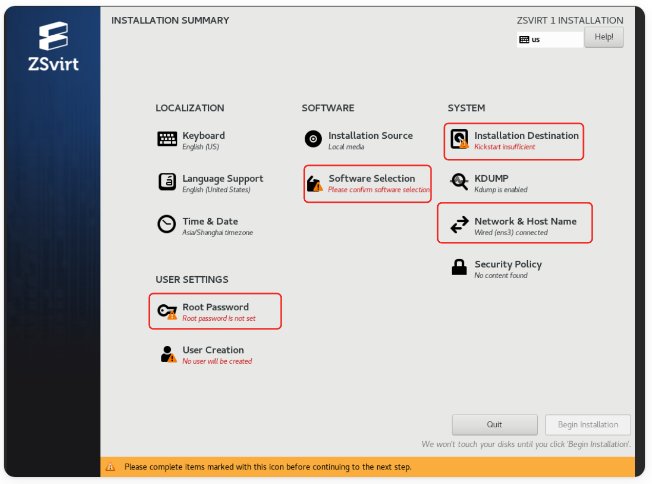
Installation starts from the 5.41 GB ISO, which installs its own operating system. The Quick Start has the administrator pick the ZSvirt Management Node option, set a static IP and root password, then sign in with the default admin/password credentials, which it says to change immediately. For a trial without spare hardware, 17.02 GB OVA and 24.02 GB QCOW2 images run the management node inside an existing hypervisor.
Key features
The figures below come from the ZSvirt homepage and VMware alternative page. ZSvirt’s own Proxmox comparison encourages buyers to reproduce results in their own lab, which is good practice with any platform.
- Scale: ZSvirt says one control plane manages 10,000+ hosts and that VMs scale to 768 vCPUs.
- Efficiency: ZSvirt claims up to a 3.8x increase in VM density and a 3x gain in performance per watt.
- Networking: ZSvirt says SR-IOV delivers up to 60x the throughput of a traditional Linux bridge and supports live migration of SR-IOV VMs.
- Overhead: the VMware alternative page claims compute overhead below 1% and more than 1M IOPS per server at under 200 microseconds of latency.
- Security: Secure Boot, vTPM 2.0, VM encryption with a built-in Native Key Provider, security groups, MFA/2FA and immutable audit logs. The README roadmap for the second half of 2026 adds VM disk encryption and migration encryption.
- Automation: 2,000+ RESTful/OpenAPI endpoints, Go, Python and Java SDKs, an official Terraform provider (Terraform 1.10.4 or later) and an MCP server that exposes read-only APIs by default.
- Operations: the press release lists HA, DRS, snapshots and backup in the community edition.
VMware migration with ZMigrate
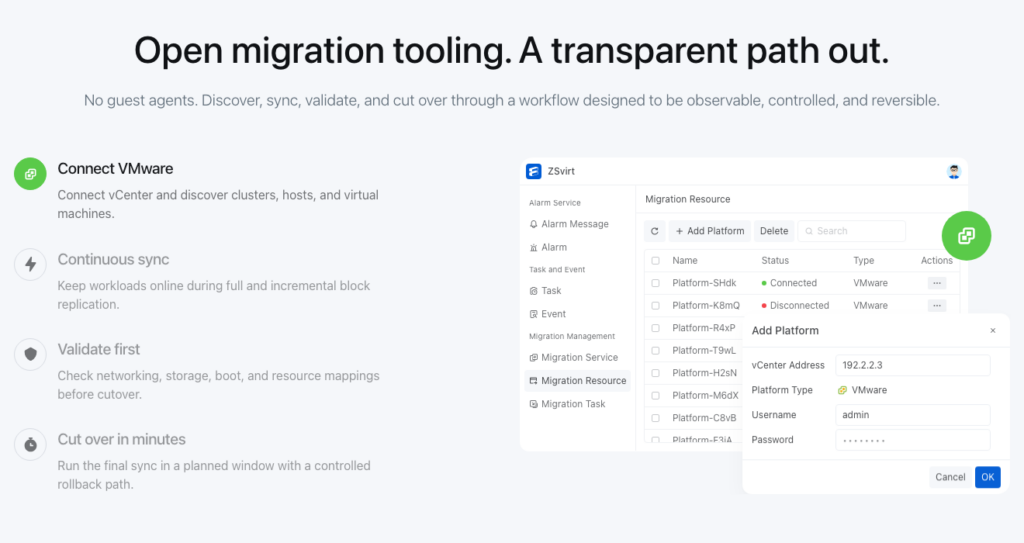
ZSvirt documents three migration paths: ZMigrate online migration, offline OVF import, and VMDK upload, where the disk is converted to qcow2 or raw. ZMigrate is a separate 8.92 GB package (version 10.1.136) that deploys from the console as VM-based services. It connects to vCenter or ESXi with credentials, runs a full sync and then incremental syncs, and cuts over with an optional rollback snapshot. ZSvirt describes it as agentless.
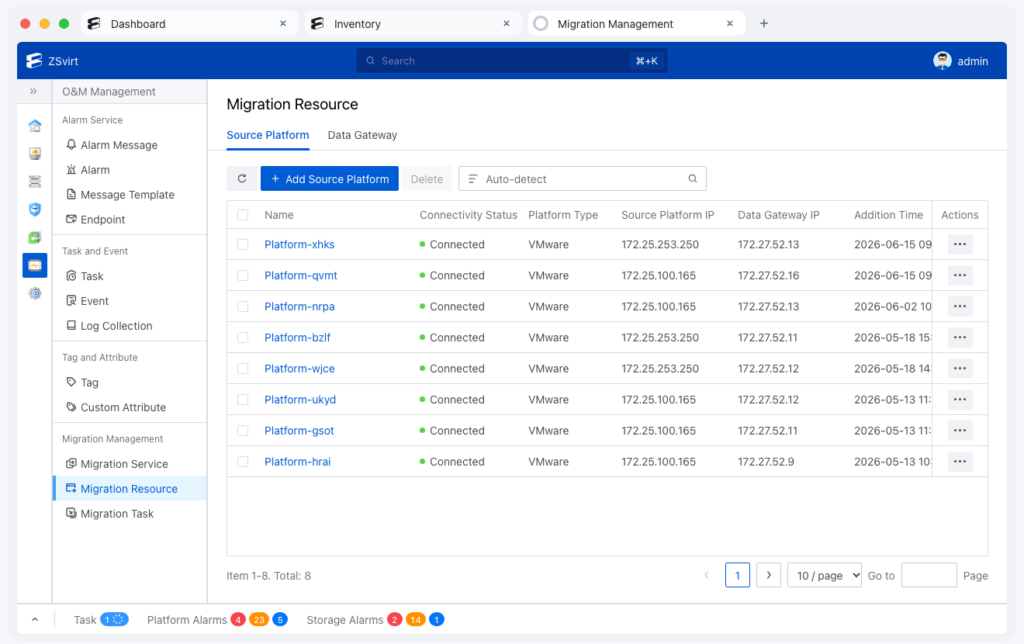
ZStack says cutover can take as little as 5 minutes per VM and that ZMigrate handles up to 50 concurrent VM migrations. It also says the current release limits online migration volume, a cap it plans to lift, while offline import is unrestricted.
Like other migration tools that read VMware disks through VMware’s VDDK library, ZMigrate uses it for VMware sources. Broadcom stopped offering public VDDK downloads in September 2026, according to a TechTarget report, so ask ZStack how VDDK access works when planning a ZMigrate project. For comparison, the Proxmox path is covered in VMware to Proxmox migration.
Support options
Community support runs through GitHub Issues, GitHub Discussions and Discord, and ZSvirt says it responds to issues on business days. Teams that want vendor-backed support can choose ZSvirt Enterprise, which adds LTS releases and SLAs, according to the VMware alternative page. Pricing comes from ZStack’s enterprise team on request.
About ZStack
ZStack was founded in 2015, according to its About page and the launch press release, which was issued from Shanghai, China and names Frank Zhang as founder and CEO. Its contact page lists a global business office in Hong Kong and a tech service center in Kuala Lumpur. The About page describes ZStack as a strategic subsidiary of Alibaba Cloud, which it says took a controlling stake in 2026, and claims more than 5,000 enterprise customers in over 30 countries and regions.
Community and project activity
GitHub figures for the ZSvirt/zsvirt repository were checked on October 27, 2026:
- 2,032 stars, 342 forks and 146 watchers, up from 1,900 stars on October 12. Commits continue, most recently on October 26, 2026.
- 4 listed contributors, with 34 issues (5 open) and 24 pull requests so far.
- Code contributions go through ZStack’s internal review workflow and sync back to GitHub, per the maintainers.
- The ZSvirt GitHub organization is growing beyond the core repository, with an MCP server, a utility repository for agents and tools (updated October 27) and a HashiCorp Packer plugin created October 16.
Installation, user and API guides are published in the ZSvirt docs, and the team keeps refining the project’s documents: on October 26 it updated the governance document to the ZSvirt name.
The launch drew early attention: Open Source For You covered the announcement on August 13, 2026, and a Show HN post on September 2 drew 72 points and 14 comments. On backup, ZSvirt’s Proxmox comparison lists Veeam, Commvault and Veritas support; confirm availability for your deployment with ZStack and your backup vendor.
ZSvirt vs Proxmox VE and XCP-ng
The table sticks to attributes checkable on each project’s own pages. For pairwise detail, see Proxmox vs VMware and XCP-ng vs Proxmox.
| ZSvirt | Proxmox VE | XCP-ng | |
|---|---|---|---|
| License | GNU GPL v3.0 | GNU AGPLv3 | Mixed open source: Xen under GPLv2 (some parts LGPLv2+ or BSD), Linux kernel GPLv2 |
| Base hypervisor | KVM, with QEMU and libvirt | KVM, plus LXC containers | Xen |
| Management | Dedicated management node (optional second for HA), web UI, REST API, CLI | Built-in web interface on every node; no dedicated manager node | Xen Orchestra web console, talking to each pool master over XAPI |
| VMware migration tooling | ZMigrate online sync and cutover, OVF import, VMDK upload | Integrated import wizard since 8.2, with live import; tested against ESXi 6.5 to 8.0 | XO V2V in Xen Orchestra: warm migration over the ESXi API |
| Paid support | ZSvirt Enterprise with SLAs; pricing on request | EUR 370 to 1,100 per CPU socket per year with tickets (EUR 120 Community tier has none) | Vates VMS: $2,000 a year for up to 3 hosts; $1,000 per host per year (3-host minimum); $1,800 per host per year with 24/7 support (4-host minimum) |
| First public release | 1.0.0 on August 12, 2026 (ZSphere dates to 2023) | 0.9 on April 15, 2008 | 7.4 on March 31, 2018 |
| Current release | 1.0.0 | 9.2 (May 21, 2026) | 8.3 LTS, supported to November 30, 2028 |
What to check before a pilot
- Edition fit: which features your deployment needs, and whether they’re in the community edition or ZSvirt Enterprise.
- Updates: how security fixes and upgrades from 1.0.0 are delivered.
- Migration plan: VDDK access, plus ZMigrate’s concurrency and disk-size limits for your largest VMs. Test a rollback, not just a cutover.
- Hardware fit: x86_64 today. Check the official compatibility list ZSvirt points buyers to, including NICs, RAID or HBA controllers and SAN arrays.
- Backup: confirm support in your backup vendor’s own compatibility matrix.
- Security baseline: change the default admin credentials, enable MFA, check audit log retention and confirm which disks VM encryption covers.
- Procurement: your standard vendor review, plus the CLA terms if your engineers will contribute code.
- Performance: test density, IOPS and cutover times with your own workloads.
- Support: if you want vendor-backed support, a written quote with SLA terms.
Bottom line
- ZSvirt is well worth a lab pilot for teams that want a VMware-style operating model (datacenter, cluster, host, distributed switch) on KVM, with 2,000+ API endpoints, Terraform and an MCP server from day one.
- It’s free under GPLv3, includes an agentless VMware migration tool, and offers vendor-backed support for teams that want it.
- As a public project it’s two months old, while Proxmox VE and XCP-ng have longer public track records, and the questions in the Proxmox enterprise-readiness assessment make a useful checklist for any of the three.
- Teams testing exit options ahead of a renewal can pair a pilot with the Broadcom renewal negotiation guide.
- Worth watching: the project is moving quickly, and its README roadmap adds VM disk encryption and migration encryption in the second half of 2026.
Frequently asked questions
Is ZSvirt free for production use?
Yes. ZSvirt is licensed under the GNU GPL v3.0, and ZStack says the community edition can run in production with no license fee. Teams that want paid support and SLAs can add ZSvirt Enterprise.
Is ZSvirt based on KVM or OpenStack?
KVM. Compute nodes run libvirt and QEMU under ZSvirt’s own management node, which comes from the ZSphere codebase. ZSvirt says it is not an OpenStack derivative.
Can ZSvirt migrate VMs from VMware?
Yes, through ZMigrate online migration, OVF import or VMDK upload. ZMigrate is agentless and supports incremental sync before cutover, with an optional rollback snapshot.
Who makes ZSvirt?
ZStack, a cloud infrastructure software company founded in 2015. Its About page describes it as a strategic subsidiary of Alibaba Cloud with more than 5,000 enterprise customers in over 30 countries and regions.
Sources
- ZSvirt Community Edition homepage
- ZSvirt: Open source alternative to VMware
- ZSvirt download center
- ZSvirt Enterprise
- ZSvirt blog: ZSvirt is open source
- ZSvirt blog: Why ZSvirt was open-sourced
- ZSvirt blog: Architecture explained
- ZSvirt blog: Three ways to migrate VMs from VMware
- ZSvirt blog: Two weeks after open-sourcing
- ZSvirt Open Source Monthly, Issue 1
- ZSvirt blog: ZSvirt vs Proxmox VE 9 (vendor comparison)
- ZSvirt docs: Quick Start
- ZSvirt docs: Installation modes
- ZSvirt docs: Hardware requirements
- ZSvirt docs: Add a data storage
- ZSvirt docs: Terraform for ZSvirt
- GitHub: ZSvirt/zsvirt (README, LICENSE, CONTRIBUTING, GOVERNANCE)
- ZStack press release via Newsfile, August 12, 2026
- ZStack: About ZStack
- TechTarget: Broadcom confirms it revoked public VMware migration tool access
- Open Source For You: ZStack open-sources ZSvirt
- Hacker News: Show HN: ZSvirt
- Proxmox VE features and pricing
- Proxmox VE roadmap and release history
- Proxmox wiki: Migrate to Proxmox VE
- XCP-ng release history and licenses
- XCP-ng docs: Migrate to XCP-ng
- Vates VMS pricing and support
Last checked: October 2026. Prices and plans change; check the vendor’s page before you buy.