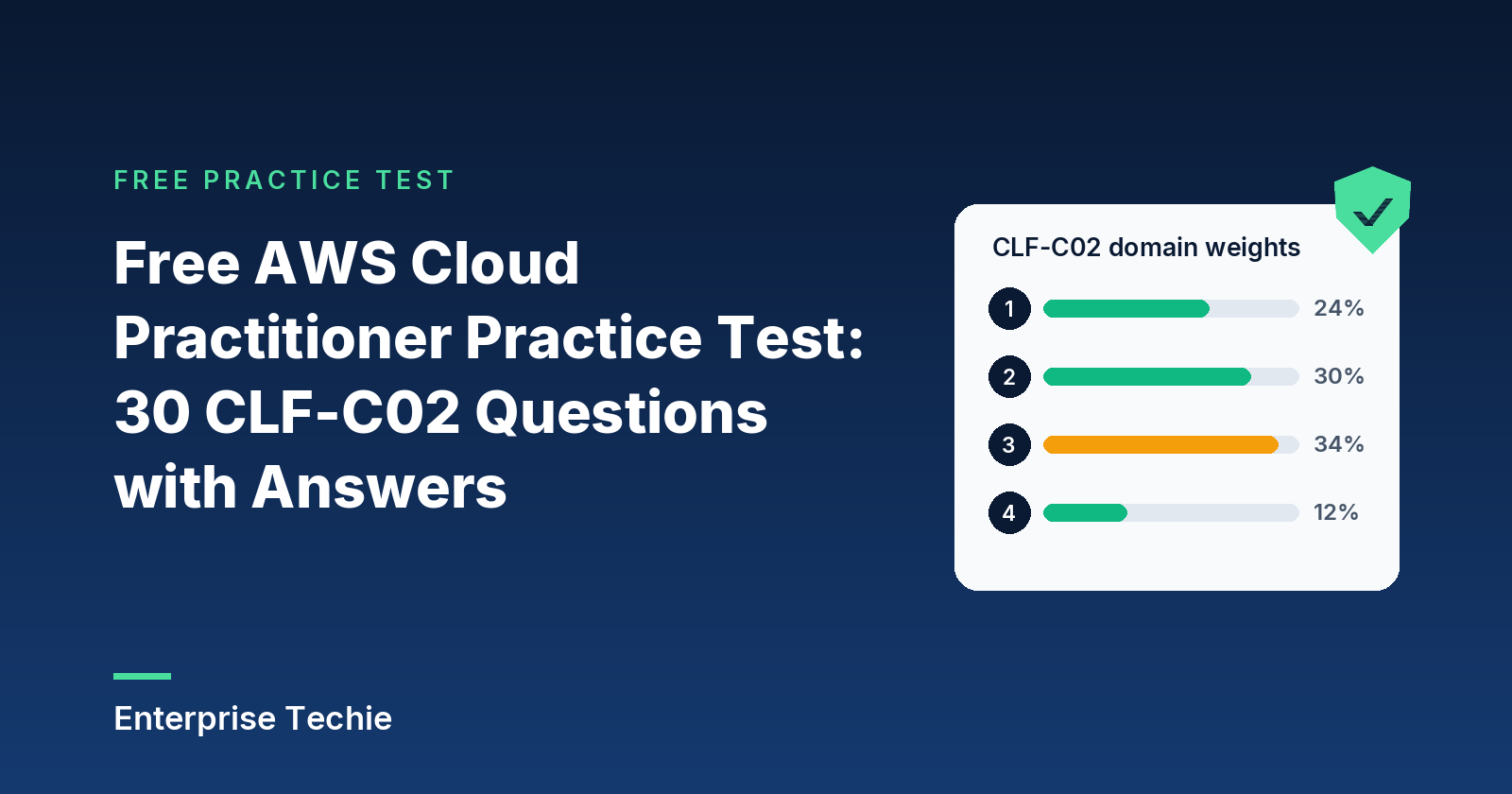
These 30 free AWS Certified Cloud Practitioner (CLF-C02) practice questions each come with the answer and an explanation. Start with the quick check: ten questions drawn at random and scored at the end. All 30 questions follow, with the answers hidden until opened.
The questions come from the Enterprise Techie question bank. Every question is written to the CLF-C02 exam objectives and checked in a separate review against primary sources such as AWS documentation. They are original practice questions, not questions from the real exam. For the material behind them, see the Cloud Practitioner study guide.
On this page
Take the 10-question quick check
Free quick check · AWS Certified Cloud Practitioner (CLF-C02)
10 random questions, scored at the end
Ten questions drawn at random from the 30 below. Each answer shows the explanation, and the score at the end can be shared. Nothing is saved and there is no sign-up.
All 30 Cloud Practitioner practice questions with answers
The 30 questions cover all 4 exam domains. Open an answer to see the explanation.
| Domain | Questions here |
|---|---|
| Cloud Concepts | 7 |
| Security and Compliance | 9 |
| Cloud Technology and Services | 10 |
| Billing, Pricing, and Support | 4 |
A startup does not want to invest heavily in data centers and servers before it knows how much capacity it will use. Which advantage of cloud computing addresses this concern?
- Increase speed and agility in provisioning
- Stop spending money on application code
- Trade fixed expense for variable expense
- Benefit from massive economies of scale
Show the answer
Answer: C. C lets the startup pay only when it consumes computing resources, and only for the amount consumed, instead of buying capacity up front. D is about lower pay-as-you-go prices from aggregated usage, A is about provisioning resources faster, and B is not one of the six advantages.
A gaming company based in North America plans to launch in Southeast Asia and wants to give players there lower latency without building any data centers. Which approach uses the benefits of the AWS global infrastructure?
- Deploy the application in an AWS Region close to those players
- Increase the size of the current Region's instances for lower latency
- Lease colocation space in Southeast Asia and ship hardware there
- Add more instances in the existing North American Region to cut latency
Show the answer
Answer: A. Deploying in multiple Regions around the world provides lower latency and a better experience at minimal cost (go global in minutes). D and B keep the workload far from the players, and C brings back the data center costs the cloud removes.
A developer needs a test environment today. On premises, procurement takes weeks. Which AWS cloud advantage does provisioning resources in minutes demonstrate?
- Trade fixed expense for variable expense
- Stop guessing capacity
- Increase speed and agility
- Benefit from massive economies of scale
Show the answer
Answer: C. New IT resources are only a click away, reducing the time to make them available from weeks to minutes, so experimentation costs less time and money. D concerns lower prices from aggregated usage, B concerns sizing, and A concerns the payment model.
A CIO wants engineers to spend time on projects that differentiate the business instead of racking, stacking, and powering servers. Which advantage of cloud computing is the CIO describing?
- Benefit from massive economies of scale
- Increase speed and agility through automation
- Go global in minutes with a few clicks
- Stop spending money running and maintaining data centers
Show the answer
Answer: D. AWS handles the heavy lifting of data center operations, so the organization can focus on its own customers and projects. C is about worldwide deployment, A is about lower pay-as-you-go prices, and B is about faster provisioning.
An online store's traffic triples during a weekly flash sale and falls back afterward. The team wants capacity to follow demand automatically in both directions. Which cloud characteristic does this describe?
- Data sovereignty
- Fault tolerance
- Vertical hardware refresh
- Elasticity
Show the answer
Answer: D. Elasticity is the ability to add resources when demand rises and remove them when it drops, for example with Amazon EC2 Auto Scaling. B is about continuing to operate after a component fails, A is about where data legally resides, and C is not an elastic scaling approach.
A web application runs on EC2 instances in a single Availability Zone. An outage in that zone took the site offline. Which change most directly improves high availability?
- Run instances in two Availability Zones behind a load balancer
- Move all instances to a larger instance type in the same zone
- Add a second EBS volume to each instance in the same zone
- Move the application to a Region that is farther from users
Show the answer
Answer: A. Availability Zones have independent power, cooling, and physical security, so spreading instances across them protects against a single-location failure. B and C stay inside the failing zone, and D does nothing for availability.
Which statement correctly defines availability for a workload?
- The percentage of time the workload is available for use
- The number of requests the workload can handle each second
- The time it takes to provision a new resource for it
- The ability to increase capacity when demand grows
Show the answer
Answer: A. Availability is available-for-use time divided by total time, such as 99.9% over a month. B describes throughput, D describes elasticity or scalability, and C describes agility.
A security questionnaire notes that physical and environmental controls at AWS data centers are fully provided by AWS. Which control category does this describe?
- Shared controls
- Inherited controls
- Customer-specific controls
- Delegated controls
Show the answer
Answer: B. B are controls a customer fully inherits from AWS, such as physical and environmental protections. A require action from both AWS and the customer. C depend on the customer's own application. D is not a category in the model.
Patch management is a shared control. For Amazon EC2, which patching task belongs to the customer?
- Updating the guest operating system and installed applications
- Patching the hypervisor on the physical hosts that run the instances
- Replacing and upgrading the physical servers that host the instances
- Updating firmware on networking devices inside AWS data centers
Show the answer
Answer: A. With EC2, the customer owns the guest operating system and software, so A is theirs. AWS patches the infrastructure, which covers B, D, and C.
A company moves a MySQL database it ran on Amazon EC2 instances to Amazon RDS for MySQL. Which task does AWS now handle instead of the company?
- Patching the database engine and the underlying operating system
- Creating database users and granting them least-privilege permissions
- Choosing which IP ranges can reach the database through security groups
- Tuning slow SQL queries to fit the application's data model
Show the answer
Answer: A. RDS is a managed service, so AWS takes over A along with backups and failover. B and C remain access decisions that the customer makes. D is application optimization, which the RDS documentation lists as the customer's job.
A developer deploys code to AWS Lambda. Which responsibility stays with the customer?
- Writing secure function code and scoping its execution role permissions
- Securing the physical data centers and hardware where the function executes
- Provisioning and scaling the fleet of compute capacity behind it
- Patching the operating system of the servers that run the function
Show the answer
Answer: A. For a serverless service, AWS runs the infrastructure and the platform, while the customer owns what they put on top: A. D, C, and B are all handled by AWS.
Configuration management is a shared control. Which activity is the customer's part?
- Configuring the hardware that hosts the virtualization layer
- Configuring the guest OS, databases, and applications they run
- Configuring the infrastructure devices that make up the AWS network
- Configuring the equipment that links AWS data centers together
Show the answer
Answer: B. AWS configures its own infrastructure devices, and the customer configures what runs on top, which is B. C, A, and D are all AWS infrastructure configuration.
Which example is a shared control in the AWS shared responsibility model?
- Awareness and training of the staff who work with systems and data
- Hardware lifecycle management for AWS-owned servers and equipment
- Physical and environmental protections for AWS data centers
- Routing or zoning customer data within specific security environments
Show the answer
Answer: A. Both parties act in A, each on its own staff. C and B are inherited from AWS, and D is customer-specific.
Some controls depend entirely on the application a customer deploys. Which is an example of a customer-specific control?
- Patching AWS-owned infrastructure devices
- Routing or zoning data within specific security environments
- Training AWS employees on security procedures
- Fire suppression systems at AWS data center facilities
Show the answer
Answer: B. B is a control the customer alone is responsible for, based on the application it deploys. D is inherited from AWS. C is AWS's side of awareness and training. A is AWS's side of patch management.
An auditor asks who is responsible for the inbound rules on the security groups attached to a company's EC2 instances. What is the correct answer?
- The customer, because network access to instances is security in the cloud
- AWS, because firewall configuration is always handled by managed services
- Both parties equally, with AWS approving each rule change
- AWS, because security groups are part of the physical network infrastructure
Show the answer
Answer: A. The EC2 documentation lists network access through the VPC and security groups as the customer's responsibility, so A is correct. D and B wrongly shift configuration to AWS, and C describes an approval step that does not exist.
A team moves a workload from EC2 instances to AWS Lambda functions. Which customer responsibility is most reduced by the move?
- Defining which principals may invoke the workload through IAM
- Managing and patching the operating system of the compute hosts
- Writing the application code securely and keeping dependencies updated
- Protecting the sensitive data that the application processes
Show the answer
Answer: B. Responsibilities shift with the service. On EC2 the customer patches the guest operating system, but on Lambda AWS manages the hosts, so B shrinks. A, D, and C stay with the customer on both services.
A systems administrator wants a shell script to stop every development EC2 instance each evening. Which tool lets the script call AWS services from a command line?
- AWS Command Line Interface (AWS CLI)
- AWS Management Console browser-based interface
- AWS Trusted Advisor dashboard
- AWS Pricing Calculator estimates
Show the answer
Answer: A. The AWS CLI gives direct access to the public APIs of AWS services from a shell, so scripts can stop instances on a schedule. B is a browser interface meant for manual use, C reports on best-practice checks, and D estimates costs; none of them runs commands against service APIs from a script.
A new team member wants to explore a service and create one test resource by pointing and clicking, with no code. Which access method suits this one-time task?
- An AWS SDK embedded in a custom application
- The AWS Management Console
- A CloudFormation template kept in version control
- A shell script that calls the service API directly
Show the answer
Answer: B. The AWS Management Console is a web interface that needs no programming, which fits a one-time exploratory task. A, C, and D all require writing code or templates, which is more effort than the task justifies and is better suited to repeatable work.
A company wants every change to its infrastructure to be reviewable like source code and reversible by redeploying an earlier definition. Which approach meets this goal?
- Create resources in the console and log each click in a shared spreadsheet
- Run ad hoc CLI commands from each engineer's own laptop as needed
- Describe resources in CloudFormation templates kept in version control
- Ask AWS Support to recreate earlier configurations on request
Show the answer
Answer: C. CloudFormation templates are text files, so tracking differences between versions tracks infrastructure changes, and an earlier template version can be redeployed to reverse a change. A and B leave no reliable, reviewable definition of the intended state, and D is not a supported way to roll back customer infrastructure.
A development team is building a Python web application that must upload files to Amazon S3 and write records to DynamoDB from inside its own code. What should the developers use to call these services?
- The Management Console, driven by a person during each file upload
- CloudFormation templates executed on every user request
- The AWS Pricing Calculator embedded in the application
- The AWS SDK for Python, which signs requests and retries failures
Show the answer
Answer: D. AWS SDKs provide language-specific APIs and take care of connection details such as calculating signatures, retrying requests, and handling errors, which is what application code needs. A depends on a human clicking, B provisions infrastructure rather than reading or writing application data, and C only estimates costs.
Developers who know TypeScript want to define infrastructure with loops and reusable components in a language they already use, and still deploy through a managed AWS provisioning service. Which tool fits?
- AWS Cloud Development Kit (AWS CDK)
- AWS Systems Manager Session Manager
- Manual steps in the AWS Management Console
- AWS Command Line Interface interactive prompts
Show the answer
Answer: A. The AWS CDK lets you define infrastructure in general-purpose languages such as TypeScript and Python and provisions it through CloudFormation. B opens shell sessions on managed nodes, C is manual and not repeatable, and D run single commands rather than defining reusable infrastructure in code.
A retailer keeps its inventory database in its own data center and runs its web tier on AWS, with the two connected. Which deployment model does this describe?
- Fully cloud-based deployment
- Hybrid deployment
- On-premises private cloud
- Single-Region deployment
Show the answer
Answer: B. A hybrid deployment connects cloud-based resources with existing resources that are not in the cloud. A would run every part of the application in the cloud, C would keep everything in the company's own facilities, and D describes where resources sit, not how cloud and non-cloud infrastructure are combined.
Which statement best describes an on-premises (private cloud) deployment model?
- Every part of the application runs on infrastructure owned by a cloud provider
- Cloud resources are linked to existing infrastructure outside the cloud
- Resources run in the organization's own facilities using virtualization tools
- Resources are placed in locations close to users but managed by AWS
Show the answer
Answer: C. On-premises deployment uses virtualization and resource management tools in the organization's own facilities and gives up many cloud benefits. A describes a cloud deployment, B describes a hybrid deployment, and D describes an extension of an AWS Region rather than a private cloud.
Security policy forbids opening inbound SSH ports or maintaining bastion hosts, yet administrators must open shell sessions on EC2 instances, with access governed by IAM and activity logged. Which capability fits?
- Amazon Inspector agent-based scans
- AWS Elastic Beanstalk environment updates
- AWS CloudFormation stack policies
- AWS Systems Manager Session Manager
Show the answer
Answer: D. Session Manager provides secure node management without open inbound ports, bastion hosts, or SSH keys, controls access through IAM policies, and can log session activity. A assess vulnerabilities rather than give shell access, B update application platforms, and C govern changes to stack resources, not interactive access to instances.
An operations team must apply operating system patches and run the same command on hundreds of managed servers, in AWS and on premises, without logging in to each one. Which service helps?
- AWS Systems Manager
- AWS CloudFormation templates
- AWS Config rules
- Amazon Route 53 hosted zones
Show the answer
Answer: A. Systems Manager lets you patch nodes at scale and run commands remotely on managed nodes in AWS and on-premises environments. B provisions resources from templates, C evaluate resource configurations against desired settings, and D handles DNS; none of them runs commands or patches across a fleet.
An engineer edited a security setting directly in the console on an EC2 instance that a CloudFormation stack created. The team wants to find resources that no longer match their template. Which CloudFormation capability does this?
- Nested stacks that split a template into reusable pieces
- Drift detection
- Template parameters that customize a stack at creation
- Stack deletion, which removes all resources in the stack
Show the answer
Answer: B. Drift detection compares a stack's actual resource configuration with the expected configuration in the template and reports resources changed outside CloudFormation. A organize templates and C supply values when creating a stack, so neither reports out-of-band changes, and D would destroy the resources instead of reporting on them.
An engineering group expects to change instance families twice during a three-year Reserved Instance term as it adopts newer hardware. It still wants a Reserved Instance discount. Which offering class meets this?
- Standard Reserved Instances, which give the larger discount but cannot be exchanged during the term
- Spot Instances, which use spare capacity and can be interrupted by EC2
- Convertible Reserved Instances, which can be exchanged for new attributes during the term
- Capacity Reservations, which hold capacity in a specific Availability Zone
Show the answer
Answer: C. C is correct: Convertible Reserved Instances can be exchanged for another Convertible Reserved Instance with a different family, type, platform, scope, or tenancy. A have a deeper discount but cannot be exchanged, so a family change would strand the commitment. B are not Reserved Instances and offer no term discount. D carry no billing discount by themselves.
A retailer needs guaranteed EC2 capacity in one Availability Zone for a two-week sales event. It does not want a one-year or three-year term, and it will cancel the capacity afterward. What should it use?
- A three-year Standard Reserved Instance for the same instance type
- On-Demand Capacity Reservations that can be cancelled at any time
- Spot Instances with a persistent request in the same zone
- A Compute Savings Plan sized to the expected event usage
Show the answer
Answer: B. B reserves capacity in a specific Availability Zone with no term commitment for immediate-use reservations, and you stop paying when you cancel. A adds a long commitment the event does not justify. C can be interrupted, so capacity is not guaranteed. D lowers the rate but does not reserve any capacity.
A healthcare firm needs its instances to run on hardware dedicated to a single customer account. It does not need to see host IDs, control placement, or use per-socket licenses, and it prefers billing per instance. Which option is the best match?
- Dedicated Hosts, billed per host with visibility of sockets and cores
- Shared-tenancy On-Demand Instances in a private subnet
- Spot Instances restricted to a single Availability Zone
- Dedicated Instances, billed per instance on single-customer hardware
Show the answer
Answer: D. D runs instances on hardware dedicated to one account and bills per instance, with no host-level visibility. A adds host control and per-host billing the firm said it does not need. B share physical servers with other customers, so subnet privacy does not change the tenancy. C still use shared spare capacity and can be interrupted.
Which TWO statements about Amazon EC2 Reserved Instances are correct? (Choose two.)
- Standard Reserved Instances can be sold in the Reserved Instance Marketplace
- A Reserved Instance is a physical server set aside for one customer for the full term
- When a Reserved Instance expires, matching instances keep running and are billed at On-Demand rates
- Convertible Reserved Instances can be sold in the Reserved Instance Marketplace once a year has passed
Show the answer
Answers: A and C. A is true: Standard Reserved Instances can be sold in the Marketplace if needs change. C is true: Reserved Instances do not renew automatically, and usage reverts to On-Demand pricing. B is wrong because a Reserved Instance is a billing discount, not a physical instance. D is wrong because Convertible Reserved Instances cannot be sold in the Marketplace.
Frequently asked questions
Are these real Cloud Practitioner exam questions?
No. They are original practice questions written to the CLF-C02 exam objectives, not questions taken from the real exam.
How many questions are on the AWS Cloud Practitioner exam?
65 questions in 90 minutes. According to the CLF-C02 exam guide, 50 of them are scored and 15 are unscored questions that AWS is testing for future use, and the unscored ones are not identified.
What is the passing score for CLF-C02?
700 on a scaled score from 100 to 1,000. The exam uses a compensatory model, so only the overall score has to pass.
Is the quick check score saved anywhere?
No. The quick check runs in the browser, and nothing is saved or sent. The share buttons create a link that carries only the score.
Sources: the questions come from the Enterprise Techie question bank. Test details are from AWS, as cited in the Cloud Practitioner study guide. Last checked: November 2026. AWS and AWS Certified Cloud Practitioner are trademarks of Amazon.com, Inc. or its affiliates. Enterprise Techie is not affiliated with or endorsed by Amazon Web Services.