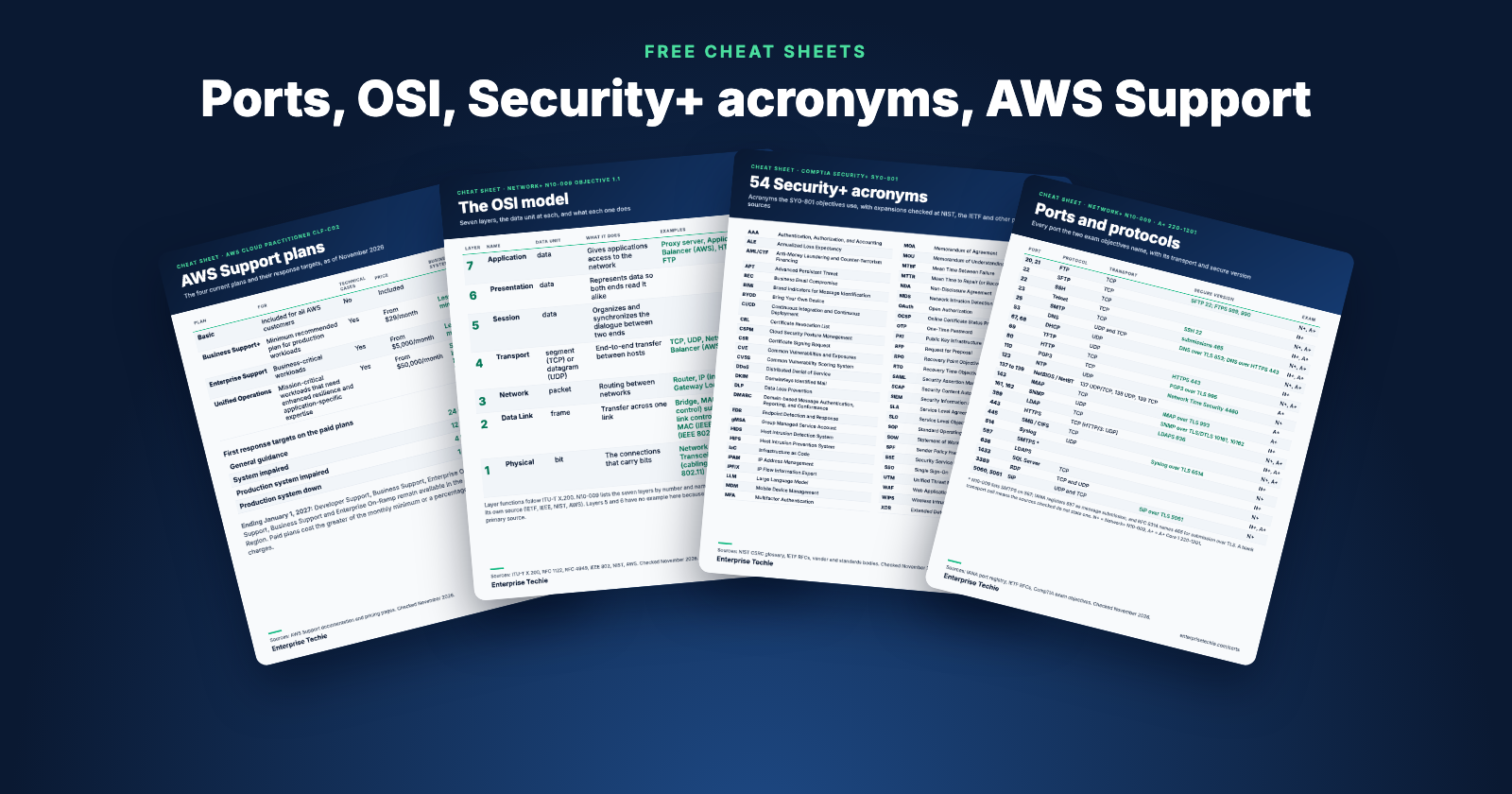
Five free one-page cheat sheets for CompTIA Network+, A+ and Security+, Cisco CCNA and AWS Certified Cloud Practitioner. Each is built from the exam objectives and checked against primary sources: the IANA port registry, IETF RFCs, ITU-T, NIST and AWS documentation. Save the images, share them, or use the tables under each one.
On this page
Ports and protocols (Network+ N10-009 and A+ 220-1201)
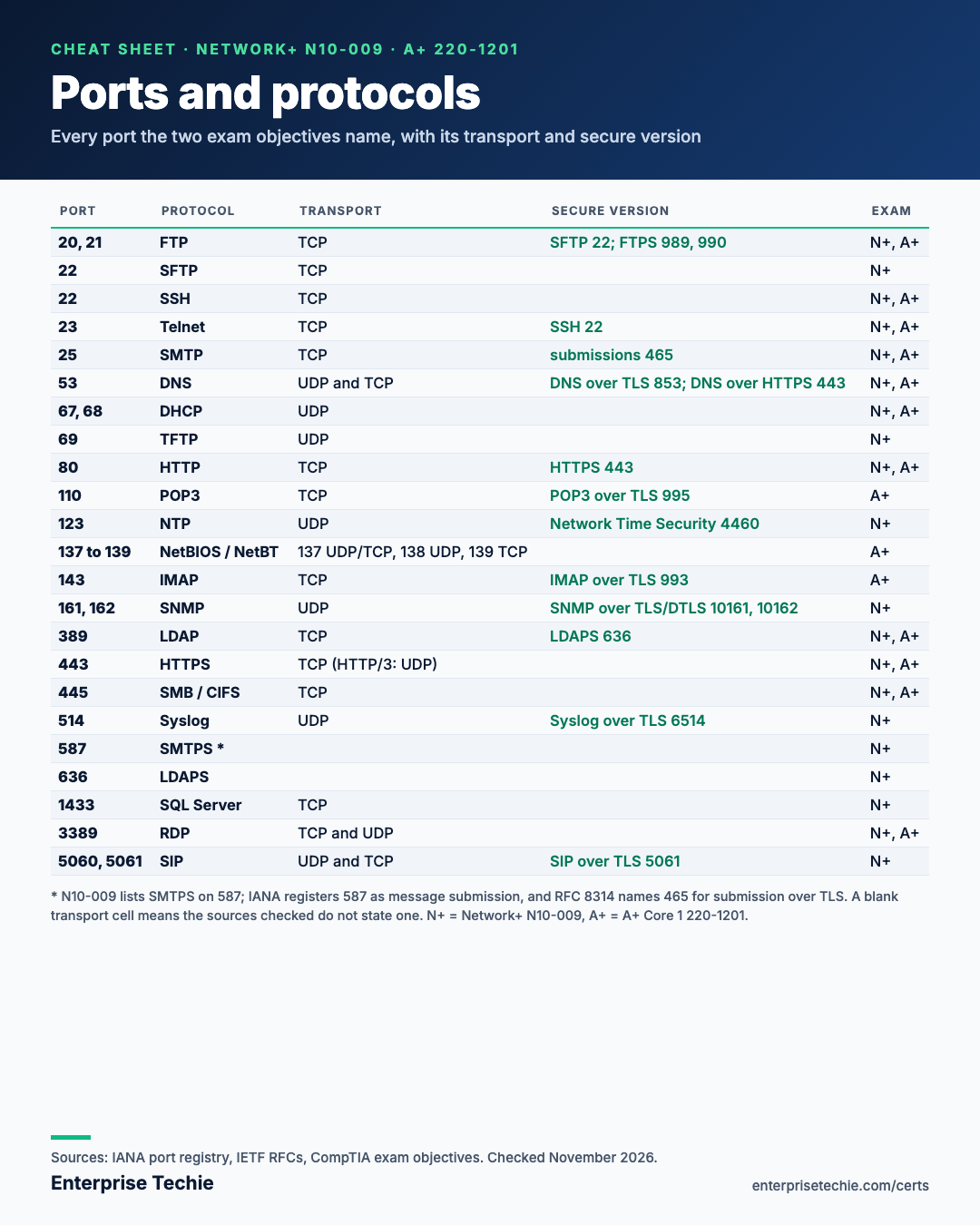
Every port that the Network+ N10-009 and A+ 220-1201 objectives name, with the transport each one uses and its secure version. Port numbers and service names are from the IANA registry; transports and secure versions are from the IETF RFCs.
Download the PNG Share on LinkedIn Pin it
| Port | Protocol | Transport | Secure version | Exam |
|---|---|---|---|---|
| 20, 21 | FTP | TCP | SFTP 22; FTPS 989, 990 | N+, A+ |
| 22 | SFTP | TCP | N+ | |
| 22 | SSH | TCP | N+, A+ | |
| 23 | Telnet | TCP | SSH 22 | N+, A+ |
| 25 | SMTP | TCP | submissions 465 | N+, A+ |
| 53 | DNS | UDP and TCP | DNS over TLS 853; DNS over HTTPS 443 | N+, A+ |
| 67, 68 | DHCP | UDP | N+, A+ | |
| 69 | TFTP | UDP | N+ | |
| 80 | HTTP | TCP | HTTPS 443 | N+, A+ |
| 110 | POP3 | TCP | POP3 over TLS 995 | A+ |
| 123 | NTP | UDP | Network Time Security 4460 | N+ |
| 137 to 139 | NetBIOS / NetBT | 137 UDP/TCP, 138 UDP, 139 TCP | A+ | |
| 143 | IMAP | TCP | IMAP over TLS 993 | A+ |
| 161, 162 | SNMP | UDP | SNMP over TLS/DTLS 10161, 10162 | N+ |
| 389 | LDAP | TCP | LDAPS 636 | N+, A+ |
| 443 | HTTPS | TCP (HTTP/3: UDP) | N+, A+ | |
| 445 | SMB / CIFS | TCP | N+, A+ | |
| 514 | Syslog | UDP | Syslog over TLS 6514 | N+ |
| 587 | SMTPS * | N+ | ||
| 636 | LDAPS | N+ | ||
| 1433 | SQL Server | TCP | N+ | |
| 3389 | RDP | TCP and UDP | N+, A+ | |
| 5060, 5061 | SIP | UDP and TCP | SIP over TLS 5061 | N+ |
* N10-009 lists SMTPS on port 587. IANA registers 587 as message submission, and RFC 8314 names port 465 for message submission over TLS. A blank transport cell means the sources checked do not state one. Related: Network+ study guide and Port Speedrun game.
The OSI model (Network+ objective 1.1)
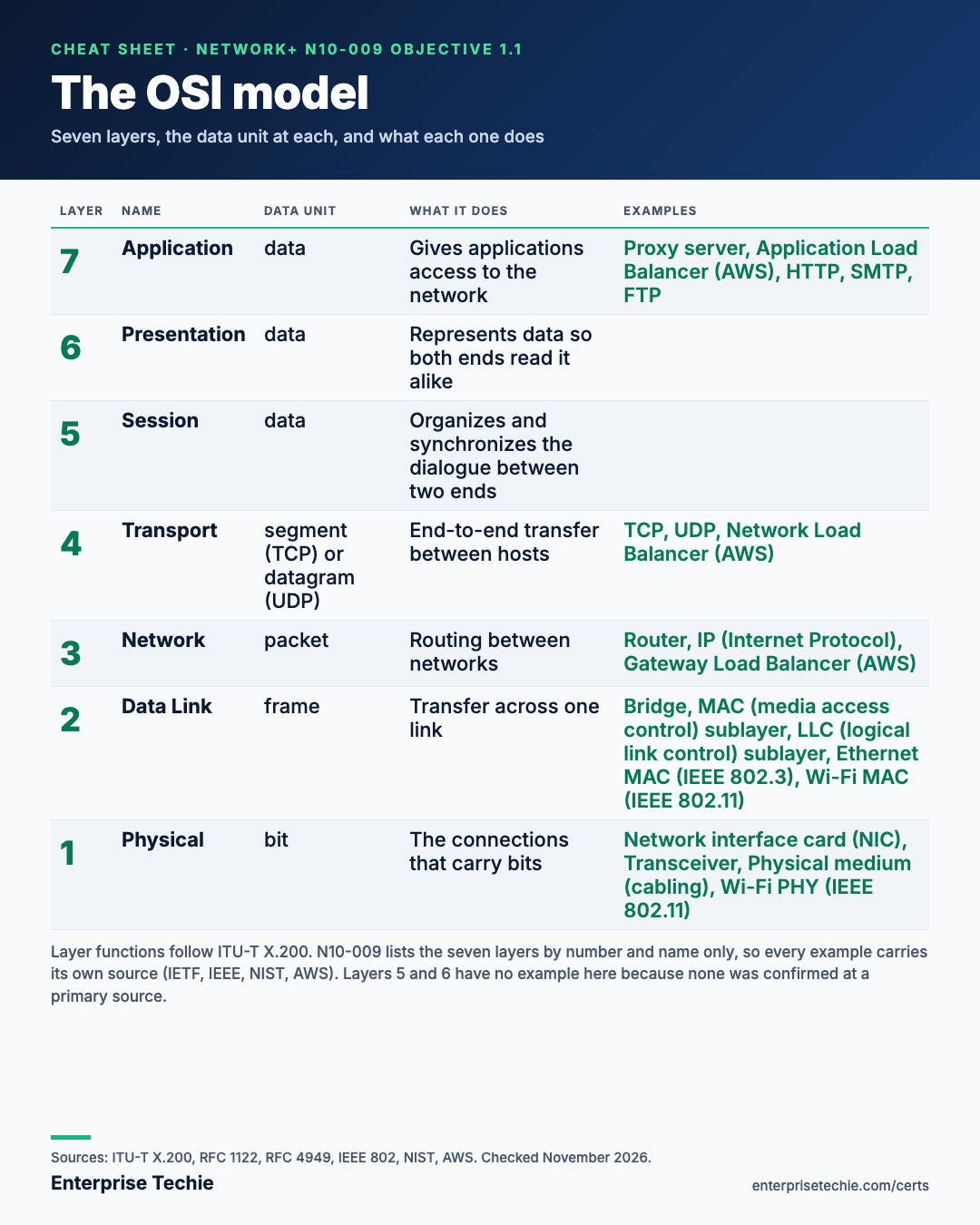
The seven layers of the OSI reference model, the data unit at each, and what each layer does. N10-009 lists the layers by number and name only, so every example here carries its own source.
Download the PNG Share on LinkedIn Pin it
| Layer | Name | Data unit | What it does | Examples |
|---|---|---|---|---|
| 7 | Application | data | Gives applications access to the network | Proxy server, Application Load Balancer (AWS), HTTP, SMTP, FTP |
| 6 | Presentation | data | Represents data so both ends read it alike | |
| 5 | Session | data | Organizes and synchronizes the dialogue between two ends | |
| 4 | Transport | segment (TCP) or datagram (UDP) | End-to-end transfer between hosts | TCP, UDP, Network Load Balancer (AWS) |
| 3 | Network | packet | Routing between networks | Router, IP (Internet Protocol), Gateway Load Balancer (AWS) |
| 2 | Data Link | frame | Transfer across one link | Bridge, MAC (media access control) sublayer, LLC (logical link control) sublayer, Ethernet MAC (IEEE 802.3), Wi-Fi MAC (IEEE 802.11) |
| 1 | Physical | bit | The connections that carry bits | Network interface card (NIC), Transceiver, Physical medium (cabling), Wi-Fi PHY (IEEE 802.11) |
Layer functions follow ITU-T X.200. Layers 5 and 6 have no example because none was confirmed at a primary source. Related: Network+ objectives explained.
54 Security+ SY0-801 acronyms
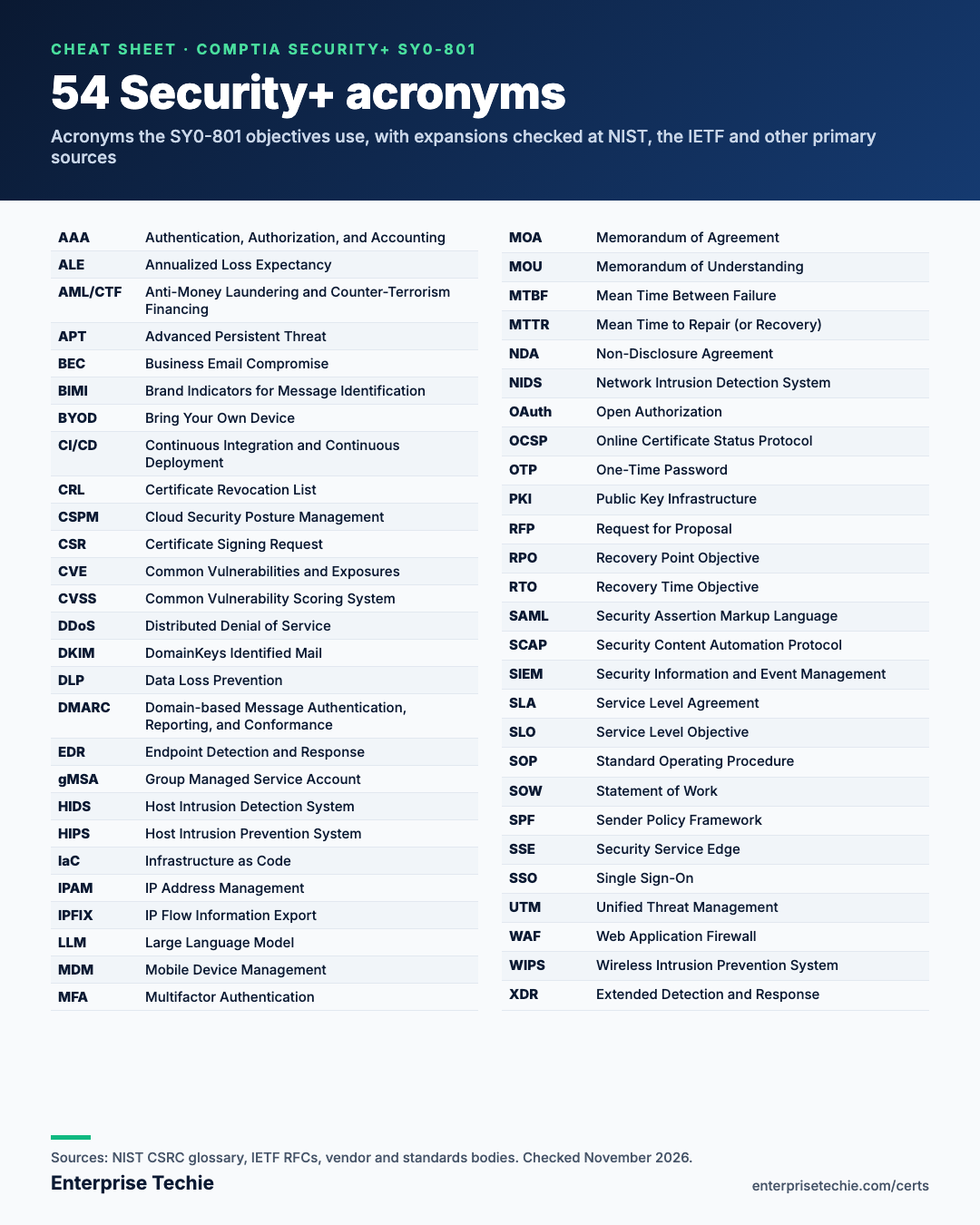
Acronyms used in the body of the SY0-801 exam objectives, spelled out from primary sources such as the NIST glossary and the IETF. Everyday acronyms such as OS and USB are left off.
Download the PNG Share on LinkedIn Pin it
| Acronym | Stands for |
|---|---|
| AAA | Authentication, Authorization, and Accounting |
| ALE | Annualized Loss Expectancy |
| AML/CTF | Anti-Money Laundering and Counter-Terrorism Financing |
| APT | Advanced Persistent Threat |
| BEC | Business Email Compromise |
| BIMI | Brand Indicators for Message Identification |
| BYOD | Bring Your Own Device |
| CI/CD | Continuous Integration and Continuous Deployment |
| CRL | Certificate Revocation List |
| CSPM | Cloud Security Posture Management |
| CSR | Certificate Signing Request |
| CVE | Common Vulnerabilities and Exposures |
| CVSS | Common Vulnerability Scoring System |
| DDoS | Distributed Denial of Service |
| DKIM | DomainKeys Identified Mail |
| DLP | Data Loss Prevention |
| DMARC | Domain-based Message Authentication, Reporting, and Conformance |
| EDR | Endpoint Detection and Response |
| gMSA | Group Managed Service Account |
| HIDS | Host Intrusion Detection System |
| HIPS | Host Intrusion Prevention System |
| IaC | Infrastructure as Code |
| IPAM | IP Address Management |
| IPFIX | IP Flow Information Export |
| LLM | Large Language Model |
| MDM | Mobile Device Management |
| MFA | Multifactor Authentication |
| MOA | Memorandum of Agreement |
| MOU | Memorandum of Understanding |
| MTBF | Mean Time Between Failure |
| MTTR | Mean Time to Repair (or Recovery) |
| NDA | Non-Disclosure Agreement |
| NIDS | Network Intrusion Detection System |
| OAuth | Open Authorization |
| OCSP | Online Certificate Status Protocol |
| OTP | One-Time Password |
| PKI | Public Key Infrastructure |
| RFP | Request for Proposal |
| RPO | Recovery Point Objective |
| RTO | Recovery Time Objective |
| SAML | Security Assertion Markup Language |
| SCAP | Security Content Automation Protocol |
| SIEM | Security Information and Event Management |
| SLA | Service Level Agreement |
| SLO | Service Level Objective |
| SOP | Standard Operating Procedure |
| SOW | Statement of Work |
| SPF | Sender Policy Framework |
| SSE | Security Service Edge |
| SSO | Single Sign-On |
| UTM | Unified Threat Management |
| WAF | Web Application Firewall |
| WIPS | Wireless Intrusion Prevention System |
| XDR | Extended Detection and Response |
Where CompTIA words an expansion differently, this sheet uses the primary source: SY0-801 writes Security Assertions Markup Language for SAML and Internet Protocol Address Management for IPAM. Related: Security+ study guide and Security+ Acronym Sprint game.
Subnet masks, /8 to /32 (Network+ and CCNA)
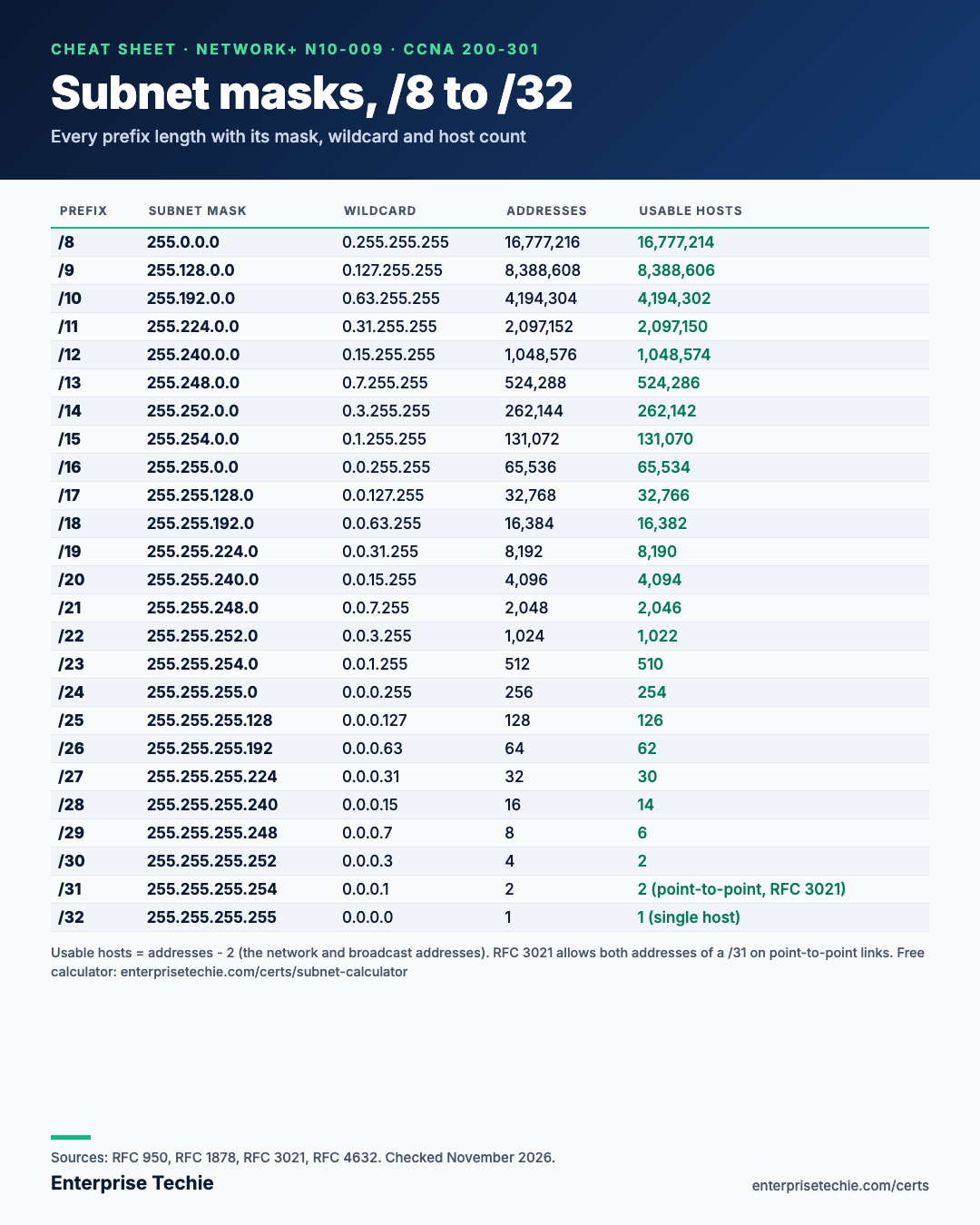
Every prefix length from /8 to /32 with its subnet mask, wildcard mask, number of addresses and usable hosts. The values are the CIDR arithmetic of RFC 4632; RFC 3021 covers the /31 exception.
Download the PNG Share on LinkedIn Pin it
| Prefix | Subnet mask | Wildcard | Addresses | Usable hosts |
|---|---|---|---|---|
| /8 | 255.0.0.0 | 0.255.255.255 | 16,777,216 | 16,777,214 |
| /9 | 255.128.0.0 | 0.127.255.255 | 8,388,608 | 8,388,606 |
| /10 | 255.192.0.0 | 0.63.255.255 | 4,194,304 | 4,194,302 |
| /11 | 255.224.0.0 | 0.31.255.255 | 2,097,152 | 2,097,150 |
| /12 | 255.240.0.0 | 0.15.255.255 | 1,048,576 | 1,048,574 |
| /13 | 255.248.0.0 | 0.7.255.255 | 524,288 | 524,286 |
| /14 | 255.252.0.0 | 0.3.255.255 | 262,144 | 262,142 |
| /15 | 255.254.0.0 | 0.1.255.255 | 131,072 | 131,070 |
| /16 | 255.255.0.0 | 0.0.255.255 | 65,536 | 65,534 |
| /17 | 255.255.128.0 | 0.0.127.255 | 32,768 | 32,766 |
| /18 | 255.255.192.0 | 0.0.63.255 | 16,384 | 16,382 |
| /19 | 255.255.224.0 | 0.0.31.255 | 8,192 | 8,190 |
| /20 | 255.255.240.0 | 0.0.15.255 | 4,096 | 4,094 |
| /21 | 255.255.248.0 | 0.0.7.255 | 2,048 | 2,046 |
| /22 | 255.255.252.0 | 0.0.3.255 | 1,024 | 1,022 |
| /23 | 255.255.254.0 | 0.0.1.255 | 512 | 510 |
| /24 | 255.255.255.0 | 0.0.0.255 | 256 | 254 |
| /25 | 255.255.255.128 | 0.0.0.127 | 128 | 126 |
| /26 | 255.255.255.192 | 0.0.0.63 | 64 | 62 |
| /27 | 255.255.255.224 | 0.0.0.31 | 32 | 30 |
| /28 | 255.255.255.240 | 0.0.0.15 | 16 | 14 |
| /29 | 255.255.255.248 | 0.0.0.7 | 8 | 6 |
| /30 | 255.255.255.252 | 0.0.0.3 | 4 | 2 |
| /31 | 255.255.255.254 | 0.0.0.1 | 2 | 2 (point-to-point, RFC 3021) |
| /32 | 255.255.255.255 | 0.0.0.0 | 1 | 1 (single host) |
Usable hosts are the addresses minus two, the network and broadcast addresses. A /31 gives two usable addresses on a point-to-point link (RFC 3021), and a /32 is a single host. Related: free subnet calculator and Subnet Speedrun game.
AWS Support plans (Cloud Practitioner CLF-C02)
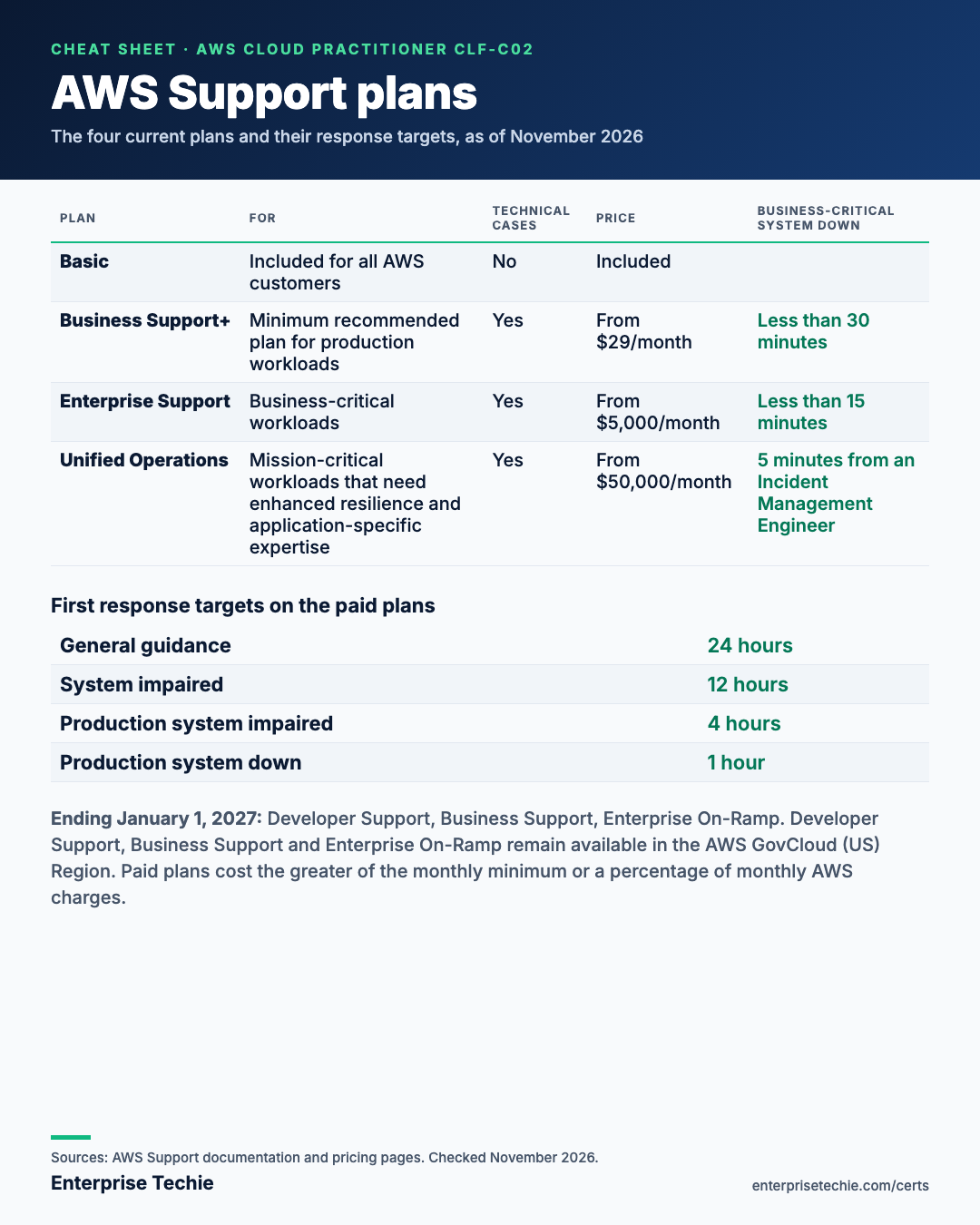
The four current AWS Support plans, their prices and response targets, and the three older plans that end on January 1, 2027. All figures are from AWS Support documentation and pricing pages as of November 2026.
Download the PNG Share on LinkedIn Pin it
| Plan | For | Technical cases | Price | Business-critical system down |
|---|---|---|---|---|
| Basic | Included for all AWS customers | No | Included | |
| Business Support+ | Minimum recommended plan for production workloads | Yes | From $29/month | Less than 30 minutes |
| Enterprise Support | Business-critical workloads | Yes | From $5,000/month | Less than 15 minutes |
| Unified Operations | Mission-critical workloads that need enhanced resilience and application-specific expertise | Yes | From $50,000/month | 5 minutes from an Incident Management Engineer |
| Severity | First response (paid plans) |
|---|---|
| General guidance | 24 hours |
| System impaired | 12 hours |
| Production system impaired | 4 hours |
| Production system down | 1 hour |
Paid plans cost the greater of the monthly minimum or a percentage of monthly AWS charges. Developer Support, Business Support and Enterprise On-Ramp end on January 1, 2027, and remain available in the AWS GovCloud (US) Region. Related: Cloud Practitioner study guide.
Frequently asked questions
Can I share these cheat sheets?
Yes. Download the images and share them, post them to a study group, or print them. Each sheet carries the Enterprise Techie name and the address of this page.
Where do the port numbers come from?
From the IANA Service Name and Transport Protocol Port Number Registry, cross-checked with the IETF RFC for each protocol and with the ports the Network+ N10-009 and A+ 220-1201 exam objectives name.
Why is a cell blank?
A blank cell means no primary source checked for this page states that value, so the sheet leaves it out rather than guess.
Sources: IANA Service Name and Transport Protocol Port Number Registry; IETF RFCs 959, 1122, 4949, 6409, 7858, 8314, 8484, 8915, 9110 and others; ITU-T X.200; IEEE 802; the NIST CSRC glossary; AWS Support documentation and pricing; CompTIA N10-009, 220-1201 and SY0-801 exam objectives. Last checked: November 2026. CompTIA, Network+, A+ and Security+ are trademarks of CompTIA, Inc. AWS is a trademark of Amazon.com, Inc. or its affiliates. Enterprise Techie is not affiliated with or endorsed by CompTIA or Amazon Web Services.