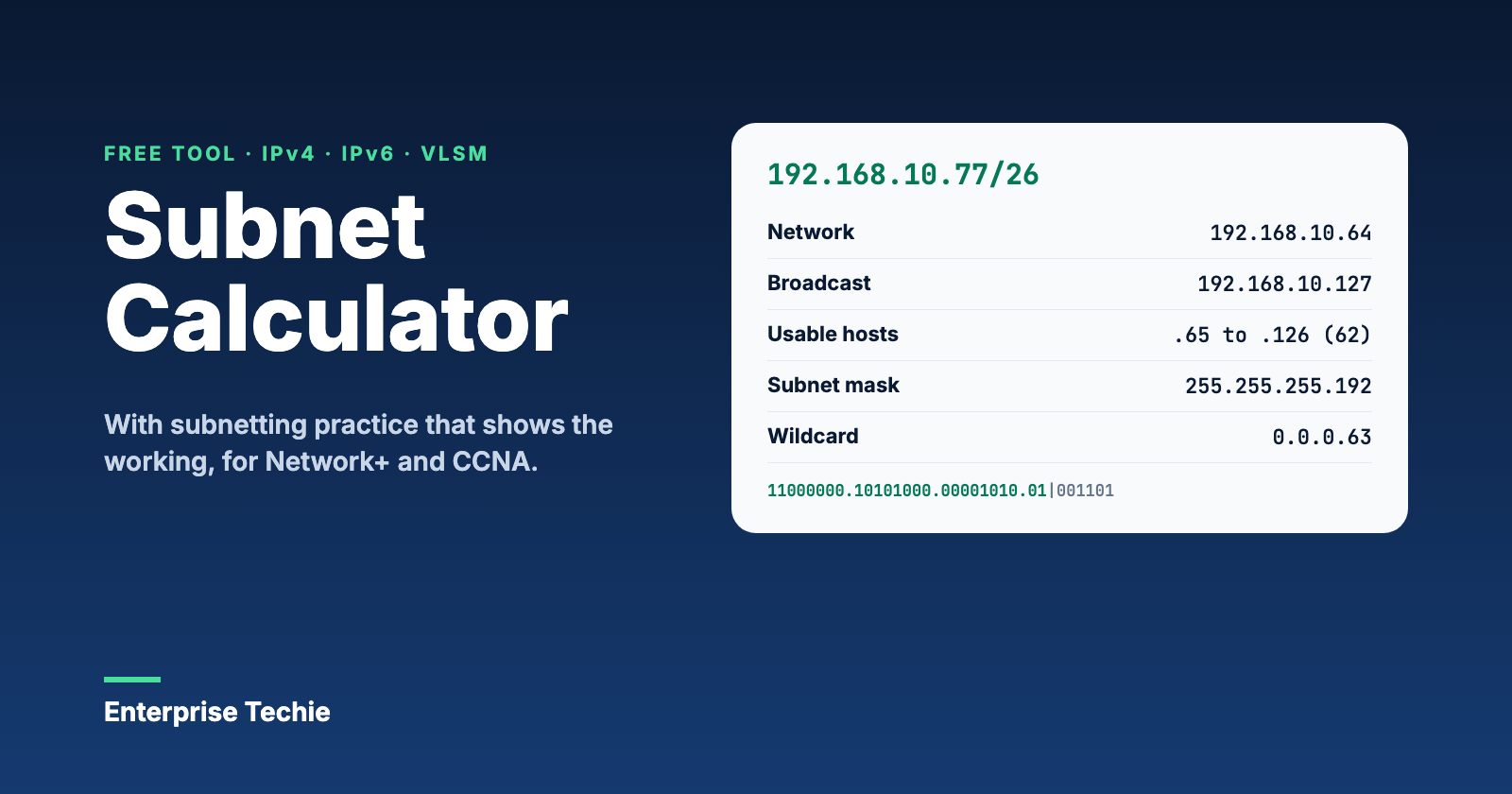
Enter an IPv4 address with a prefix or a subnet mask to get the network and broadcast addresses, the usable host range, the subnet and wildcard masks and the address type. The other tabs split a network into equal subnets, build a VLSM plan from a list of host counts, work out IPv6 prefixes, and generate practice problems with the working shown. It all runs in the browser, and nothing typed here is sent anywhere.
On this page
How to subnet by hand: the block-size method
Take 192.168.10.77/26, the calculator’s default. A /26 has 26 network bits, so the mask is 255.255.255.192. The fourth octet is the interesting one, because its mask value is 192 rather than 255 or 0.
- Block size: 256 – 192 = 64, so the /26 subnets start at .0, .64, .128 and .192.
- The address ends in .77, which falls in the block that starts at .64.
- Network address: 192.168.10.64. Broadcast address: 192.168.10.127, the last address before the next block.
- Usable hosts: 192.168.10.65 to 192.168.10.126, which is 2^6 – 2 = 62 hosts.
The same steps work for any prefix: find the octet where the mask is neither 255 nor 0, subtract its value from 256 for the block size, and find the block the address falls in. The Practice tab generates problems and shows these steps for each one.
Prefix lengths at a glance
| Prefix | Subnet mask | Wildcard mask | Addresses | Usable hosts |
|---|---|---|---|---|
| /16 | 255.255.0.0 | 0.0.255.255 | 65,536 | 65,534 |
| /17 | 255.255.128.0 | 0.0.127.255 | 32,768 | 32,766 |
| /18 | 255.255.192.0 | 0.0.63.255 | 16,384 | 16,382 |
| /19 | 255.255.224.0 | 0.0.31.255 | 8,192 | 8,190 |
| /20 | 255.255.240.0 | 0.0.15.255 | 4,096 | 4,094 |
| /21 | 255.255.248.0 | 0.0.7.255 | 2,048 | 2,046 |
| /22 | 255.255.252.0 | 0.0.3.255 | 1,024 | 1,022 |
| /23 | 255.255.254.0 | 0.0.1.255 | 512 | 510 |
| /24 | 255.255.255.0 | 0.0.0.255 | 256 | 254 |
| /25 | 255.255.255.128 | 0.0.0.127 | 128 | 126 |
| /26 | 255.255.255.192 | 0.0.0.63 | 64 | 62 |
| /27 | 255.255.255.224 | 0.0.0.31 | 32 | 30 |
| /28 | 255.255.255.240 | 0.0.0.15 | 16 | 14 |
| /29 | 255.255.255.248 | 0.0.0.7 | 8 | 6 |
| /30 | 255.255.255.252 | 0.0.0.3 | 4 | 2 |
Usable hosts are the addresses minus two, for the network and broadcast addresses. A /31 is the exception: RFC 3021 lets both of its addresses be used on a point-to-point link. Every prefix from /8 to /32 is on the subnet mask cheat sheet.
Special IPv4 ranges
| Range | Use | Defined in |
|---|---|---|
| 10.0.0.0/8 | Private | RFC 1918 |
| 172.16.0.0/12 | Private | RFC 1918 |
| 192.168.0.0/16 | Private | RFC 1918 |
| 100.64.0.0/10 | Shared address space for carrier-grade NAT | RFC 6598 |
| 127.0.0.0/8 | Loopback | RFC 1122 |
| 169.254.0.0/16 | Link-local, used by APIPA | RFC 3927 |
| 192.0.2.0/24, 198.51.100.0/24, 203.0.113.0/24 | Documentation (TEST-NET-1, 2 and 3) | RFC 5737 |
| 198.18.0.0/15 | Benchmarking | RFC 2544 |
| 224.0.0.0/4 | Multicast | RFC 5771 |
| 240.0.0.0/4 | Reserved (former Class E) | RFC 1112 |
| 255.255.255.255/32 | Limited broadcast | RFC 919 |
The IPv4 tab names the range an address belongs to. Anything outside these ranges is shown as public.
IPv6 prefixes
IPv6 addresses are 128 bits long (RFC 4291), written as eight groups of four hexadecimal digits. The IPv6 tab shows both forms: the expanded one, and the compressed one that RFC 5952 recommends, with leading zeros dropped and the longest run of zero groups replaced by “::”. It also gives the first and last address of the prefix, the number of /64 subnets it holds, and the address type, such as link-local (fe80::/10), unique local (fc00::/7, RFC 4193) or documentation (2001:db8::/32, RFC 3849).
Subnetting on the exams
Subnetting sits in CompTIA Network+ N10-009 objective 1.7 (“Given a scenario, use appropriate IPv4 network addressing”) and in Cisco CCNA 200-301 v2.0 topic 1.3, which covers troubleshooting IPv4 addressing and subnetting. Practise with the Subnet Speedrun game, then read the Network+ study guide or the CCNA study guide.
Frequently asked questions
How many usable hosts are in a /24?
254. A /24 has 256 addresses, and the network and broadcast addresses cannot be assigned to hosts.
What is a /31 used for?
Point-to-point links. RFC 3021 allows both addresses in a /31 to be used as host addresses, because a link with only two ends needs no broadcast address.
What is the subnet mask for a /27?
255.255.255.224. That leaves 5 host bits: 32 addresses and 30 usable hosts.
What is a wildcard mask?
The inverse of the subnet mask, where a 0 bit must match and a 1 bit is ignored. Cisco ACLs use wildcard masks; for a /27 it is 0.0.0.31.
What is VLSM?
Variable-length subnet masking: dividing one network into subnets of different sizes, so each gets only the addresses it needs. The VLSM tab allocates the largest subnet first, so every block starts on a boundary of its own size.
Is anything typed into the calculator sent to a server?
No. The calculator runs entirely in the browser.
Sources: RFC 950 (subnetting), RFC 1878 (subnet table), RFC 3021 (/31), RFC 4632 (CIDR), RFC 1918, RFC 6598, RFC 1122, RFC 3927, RFC 5737, RFC 2544, RFC 5771, RFC 1112, RFC 919, RFC 4291, RFC 5952, RFC 4193 and RFC 3849; CompTIA N10-009 exam objectives; Cisco CCNA 200-301 v2.0 exam topics. The calculator’s math is tested against Python’s ipaddress module. Last checked: November 2026. CompTIA and Network+ are trademarks of CompTIA, Inc. Cisco and CCNA are trademarks of Cisco Systems, Inc. Enterprise Techie is not affiliated with or endorsed by CompTIA or Cisco.