AWS publishes an exam guide for every certification, and for the AWS Certified Cloud Practitioner exam it is the official map of what CLF-C02 tests. It splits the exam into four domains, breaks each domain into task statements (19 in all), and adds reference lists of in-scope services, out-of-scope services, and technologies and concepts. This page walks through that guide in plain English: the test details, the domains and their weights, what each task statement covers, and how to turn it into a study plan.
Unless another source is named, every fact below comes from AWS’s AWS Certified Cloud Practitioner (CLF-C02) exam guide, version 1.3, published October 29, 2026, and the AWS Certified Cloud Practitioner exam page.
In this guide
CLF-C02 at a glance
| Exam code | CLF-C02 (AWS Certified Cloud Practitioner) |
|---|---|
| Level | Foundational |
| Questions | 65: 50 scored and 15 unscored, and the unscored ones are not identified |
| Question types | Multiple choice and multiple response |
| Time | 90 minutes |
| Passing score | 700 on a scaled score from 100 to 1,000 |
| Recommended experience | Up to 6 months of exposure to the AWS Cloud, not required |
| Delivery | Pearson VUE test center or online proctored |
| Exam guide version | 1.3, published October 29, 2026 |
The guide has been revised three times since version 1.0 was published on June 24, 2026, according to its revisions page, and AWS says it publishes updates roughly a month before they reach the exam. Check the version number on the guide before test day, and treat any study material that predates it with some care.
The four domains and their weights
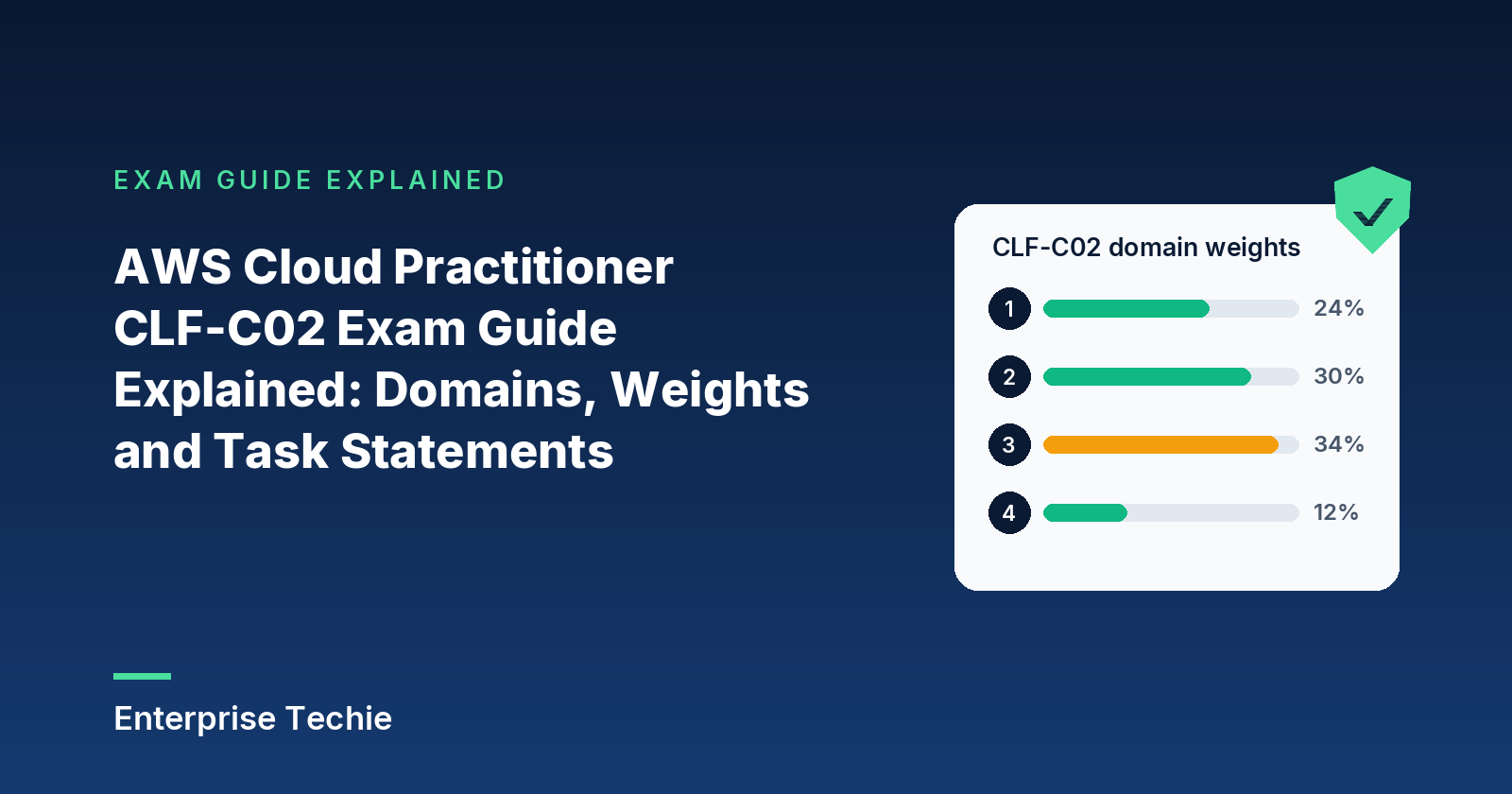
Each domain carries a percentage of the scored content. The task statement counts come from the guide’s own domain pages.
| Domain | Share of scored content | Task statements |
|---|---|---|
| 1 Cloud Concepts | 24% | 4 |
| 2 Security and Compliance | 30% | 4 |
| 3 Cloud Technology and Services | 34% | 8 |
| 4 Billing, Pricing, and Support | 12% | 3 |
| Total | 100% | 19 |
Two things stand out. Cloud Technology and Services is the heaviest domain at 34 percent and holds eight of the 19 task statements, six of which ask candidates to identify services. And Domains 2 and 3 together account for 64 percent of the scored content, so security and services make up most of the exam.
The scoring is compensatory: only the overall score needs to reach the passing mark. AWS warns that the section-level feedback on the score report is general information, so read it with caution.
How to read a task statement
Each task statement opens with a verb, and the verbs set the depth. All but one say define, identify or understand; 4.1 (pricing models) says compare. Under each task statement, AWS lists two things: Knowledge of, the topics a candidate should know, and Skills in, what a candidate should be able to do with them, such as recognizing the right service for a need or describing how something works.
AWS is clear that the guide is not a complete list of exam content, and that its in-scope service list is non-exhaustive and subject to change. The examples in parentheses (“for example, …”) are a sample of each topic. The guide also names five kinds of work it does not expect of candidates: coding, designing cloud architecture, troubleshooting, implementation, and load and performance testing.
Domain 1: Cloud Concepts (24%)
Why organizations use the AWS Cloud, how AWS says to design for it, how they move to it, and how its costs behave. Four task statements, and few service names.
- 1.1 Benefits of the AWS Cloud. The value proposition of AWS, including what global infrastructure adds (fast deployment and worldwide reach) and the advantages of high availability, elasticity and agility.
- 1.2 Design principles. The AWS Well-Architected Framework: its pillars (operational excellence, security, reliability, performance efficiency, cost optimization and sustainability) and how they differ from one another.
- 1.3 Migration benefits and strategies. Cloud adoption strategies and the resources that support a migration: the components and outcomes of the AWS Cloud Adoption Framework (AWS CAF), such as lower business risk, better ESG performance, more revenue and more efficient operations, and how to pick a migration strategy, with database replication as AWS’s example.
- 1.4 Cloud economics. Fixed versus variable costs, what on-premises environments cost, licensing choices (Bring Your Own License or licenses included in the price), rightsizing, the payoff from automation, and economies of scale.
Study note: two lists of six are easy to blur here. AWS’s six advantages of cloud computing, from its overview whitepaper, support 1.1; the six Well-Architected pillars are 1.2. For 1.3, the 7 Rs in AWS Prescriptive Guidance (retire, retain, rehost, relocate, repurchase, replatform, refactor) are AWS’s names for migration strategies.
Domain 2: Security and Compliance (30%)
Who secures what, how compliance and logging work, how access is managed, and which security services AWS offers. Four task statements.
- 2.1 The shared responsibility model. Its components, what AWS is responsible for, what customers are responsible for, what the two share, and how the split moves from service to service. The guide uses Amazon RDS, AWS Lambda and Amazon EC2 as its examples.
- 2.2 Security, governance, and compliance concepts. Where to find AWS compliance information (AWS Artifact), how compliance needs differ by country, industry and service, the benefits of encryption at rest and in transit, the services that protect resources (GuardDuty, Inspector, Security Hub and Shield), and where security logs come from: CloudWatch for monitoring, CloudTrail and Config for auditing, and access reports.
- 2.3 Access management. AWS Identity and Access Management (IAM), protecting the root user and the tasks only it can perform, least privilege, and AWS IAM Identity Center. Also access keys, password policies and where to store credentials (AWS Secrets Manager, AWS Systems Manager), authentication methods such as MFA and cross-account roles, users, groups and policies, and federated identity.
- 2.4 Security components and resources. AWS security services such as AWS WAF, AWS Firewall Manager, AWS Shield and Amazon GuardDuty; third-party security products in AWS Marketplace; where AWS publishes security information (the AWS Security Blog, the AWS Security Center and the AWS Knowledge Center); and AWS Trusted Advisor for spotting security issues.
Study note: 2.1 is the foundation for the rest of the domain. AWS’s Amazon RDS documentation includes a table comparing who manages what on premises, on EC2 and on RDS, which shows the shift the task statement describes. In 2.3, learn the root-only tasks by name, because they are a specific, finite list.
Domain 3: Cloud Technology and Services (34%)
The largest domain: eight task statements, mostly about recognizing which service fits a need.
- 3.1 Deploying and operating. Ways to provision and access AWS (APIs, SDKs, the CLI, the AWS Management Console and infrastructure as code), when a one-time operation is enough and when a repeatable process is needed, and the cloud, hybrid and on-premises deployment models.
- 3.2 Global infrastructure. How Regions, Availability Zones and edge locations relate, high availability through several AZs (which share no single points of failure), the benefits of edge locations, and reasons to use more than one Region, such as data sovereignty, disaster recovery, business continuity and lower latency for users.
- 3.3 Compute. When to use different EC2 instance types, container options (Amazon ECS, Amazon EKS) and serverless options (AWS Fargate, AWS Lambda), the fact that auto scaling provides elasticity, and what load balancers are for.
- 3.4 Databases. Choosing a database hosted on EC2 or a managed AWS database, recognizing relational (Amazon RDS, Amazon Aurora), NoSQL (Amazon DynamoDB) and in-memory (Amazon ElastiCache) databases, and the migration tools AWS DMS and AWS SCT.
- 3.5 Networking. The parts of a VPC, such as subnets and gateways, security inside a VPC (security groups, network ACLs, Amazon Inspector), what Amazon Route 53 does, and ways to connect to AWS, such as AWS VPN and AWS Direct Connect.
- 3.6 Storage. Uses for object storage, the differences between Amazon S3 storage classes, block storage (Amazon EBS and instance store), file services (Amazon EFS, Amazon FSx), cached file systems (AWS Storage Gateway), and when lifecycle policies and AWS Backup help.
- 3.7 AI/ML and analytics. What AI and machine learning services do, with Amazon SageMaker AI and Amazon Lex as examples, and which services handle data analytics, such as Amazon Athena, Amazon Kinesis, AWS Glue and Amazon Quick.
- 3.8 Other in-scope categories. Messaging and notifications (Amazon EventBridge, Amazon SNS, Amazon SQS), business applications (Amazon Connect, Amazon SES), customer enablement (AWS Support), developer tools (AWS CodeBuild, AWS CodePipeline, AWS X-Ray), end-user computing (Amazon WorkSpaces, Amazon AppStream 2.0, Amazon WorkSpaces Secure Browser), AWS Amplify for web and mobile frontends, and AWS IoT Core for IoT devices.
Study note: this domain rewards breadth. For each service named above, be able to say in one sentence what it is for and which similar service it is not. Pairs worth drilling: security groups and network ACLs, EBS and EFS, DMS and SCT, SNS and SQS, Fargate and Lambda.
Domain 4: Billing, Pricing, and Support (12%)
The smallest domain, but dense with vocabulary. Three task statements.
- 4.1 Pricing models. The compute purchasing options (On-Demand Instances, Savings Plans, Reserved Instances, Spot Instances, Dedicated Hosts, Dedicated Instances and Capacity Reservations) and when to use each, how flexible Reserved Instances are and how they behave in AWS Organizations, data transfer costs into and out of AWS, between Regions and within a Region, and pricing for storage options and tiers.
- 4.2 Billing, budget, and cost management. Billing support and pricing information, AWS Organizations consolidated billing and cost allocation, cost allocation tags and how they relate to billing reports such as the AWS Cost and Usage Report, and what AWS Budgets, AWS Cost Explorer and AWS Pricing Calculator are each for.
- 4.3 Technical resources and Support. Where AWS publishes whitepapers, blogs and documentation; resources such as AWS Prescriptive Guidance, the AWS Knowledge Center and AWS re:Post; the AWS Support plans and AWS Support Center; Trusted Advisor, the AWS Health Dashboard and the AWS Health API; the AWS Trust and Safety team for reporting abuse; AWS Partners, ISVs, system integrators and AWS Marketplace; and AWS Professional Services and solutions architects.
Study note: the Support plan names in this version of the guide are new. It names Basic Support, AWS Business Support+, AWS Enterprise Support and AWS Unified Operations, which match the four plans AWS offers today. AWS’s end-of-support notice says the older Developer, Business and Enterprise On-Ramp plans end on January 1, 2027, outside the AWS GovCloud (US) Region, so older study material that teaches those plans is out of date.
Where AWS services show up
Beyond the task statements, the guide has three reference lists. The in-scope services list groups 111 services and features into 19 categories by primary function. The largest categories are Security, Identity, and Compliance (18 entries), Management and Governance (16) and Networking and Content Delivery (11). Those counts describe the list itself.
The out-of-scope list is just as useful, because some names sit right next to in-scope ones. Amazon FSx is in scope but Amazon FSx for Lustre is not. AWS Billing Conductor, AWS Wavelength, AWS Network Firewall, AWS Transfer Family, Amazon GameLift and the AWS Elemental media services are out. The guide’s revisions page also lists eight services removed from the out-of-scope list, including Amazon WorkDocs and AWS RoboMaker.
The technologies and concepts list names topics that might appear, from APIs and infrastructure as code to the AWS Partner Network, AWS re:Post and AWS Support Center. AWS states that the order of that list says nothing about weight.
A few names in the guide differ from AWS’s current documentation, so knowing both helps:
| Name in the exam guide | Name in AWS’s current documentation |
|---|---|
| Amazon Quick | Amazon Quick, which evolved from Amazon QuickSight; its BI feature is Amazon Quick Sight |
| AWS Security Hub | AWS Security Hub CSPM for the posture-management checks |
| Amazon Connect | Amazon Connect Customer for the contact center product |
| Amazon AppStream 2.0 | Amazon WorkSpaces Applications |
| AWS Application Migration Service | AWS Transform MGN, in AWS’s migration services overview |
How to study the exam guide
- Turn the guide into a checklist. Open the exam guide and tick off each Knowledge and Skills bullet as it becomes familiar. Gaps show up quickly.
- Split study time by weight. Domains 2 and 3 are 64 percent of the scored content, so they deserve most of the hours. Domain 4 is the smallest at 12 percent, but its terms (Savings Plans, consolidated billing, Support plan names) are quick points once learned.
- Work through the in-scope list a category at a time. For each service, write one sentence on what it does. The AWS Cloud Practitioner study guide covers every task statement with tables that map needs to services.
- Test against the domains, then read the explanations. Practice questions show which task statements are solid and which are not, and the explanation for a missed question usually teaches more than the question itself.
Practice against the exam guide
Try 30 free Cloud Practitioner practice questions with answers and explanations, plus a 10-question quick check scored at the end. No sign-up.
Frequently asked questions
How many task statements are in the CLF-C02 exam guide?
19: four in Cloud Concepts, four in Security and Compliance, eight in Cloud Technology and Services, and three in Billing, Pricing, and Support.
What are the CLF-C02 domain weights?
Cloud Concepts 24%, Security and Compliance 30%, Cloud Technology and Services 34%, and Billing, Pricing, and Support 12% of the scored content.
How many questions are on CLF-C02, and how many are scored?
65 questions in 90 minutes. 50 are scored and 15 are unscored questions that AWS is evaluating for future use, and the exam does not say which ones they are.
What is the passing score for CLF-C02?
700 on a scaled score from 100 to 1,000. The scoring is compensatory, so only the overall score has to pass.
Is everything on the exam listed in the exam guide?
No. AWS says the guide is not a comprehensive list of exam content, and both service lists are non-exhaustive and subject to change.
When was the CLF-C02 exam guide last updated?
Version 1.3 was published on October 29, 2026. AWS publishes exam guide updates about one month before they are reflected on the exam.
Which AWS Support plans does the CLF-C02 exam guide name?
Basic Support, AWS Business Support+, AWS Enterprise Support and AWS Unified Operations, along with customer service and communities. These are the four plans AWS offers today.
Sources: AWS Certified Cloud Practitioner (CLF-C02) exam guide, version 1.3, with its in-scope services, out-of-scope services, technologies and concepts and revisions pages; AWS Certified Cloud Practitioner exam page; AWS Support plans and end-of-support notice; AWS documentation linked above for individual services. Last checked: November 2026. AWS and AWS Certified Cloud Practitioner are trademarks of Amazon.com, Inc. or its affiliates. Enterprise Techie is not affiliated with or endorsed by Amazon Web Services (AWS).