These 30 free CompTIA Network+ N10-009 practice questions each come with the answer and an explanation. Start with the quick check: ten questions drawn at random and scored at the end. All 30 questions follow, with the answers hidden until opened.
The questions come from the Enterprise Techie question bank. Every question is written to the N10-009 exam objectives and checked in a separate review against primary sources such as IETF RFCs, NIST and vendor networking documentation. They are original practice questions, not questions from the real exam. For the material behind them, see the Network+ study guide.
On this page
Take the 10-question quick check
Free quick check · CompTIA Network+ N10-009
10 random questions, scored at the end
Ten questions drawn at random from the 30 below. Each answer shows the explanation, and the score at the end can be shared. Nothing is saved and there is no sign-up.
All 30 Network+ practice questions with answers
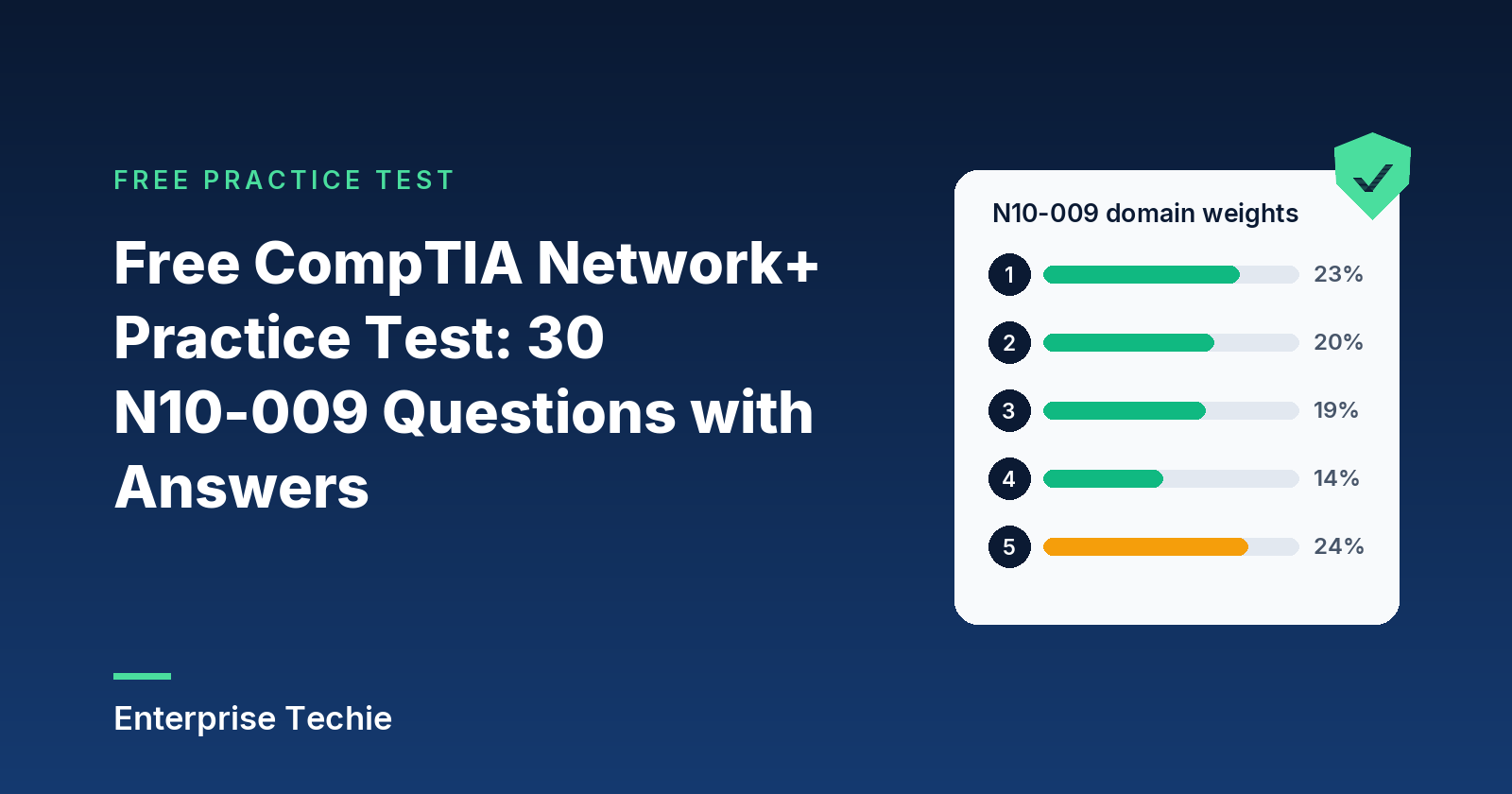
The 30 questions cover all 5 exam domains. Open an answer to see the explanation.
| Domain | Questions here |
|---|---|
| Networking Concepts | 7 |
| Network Implementation | 6 |
| Network Operations | 6 |
| Network Security | 4 |
| Network Troubleshooting | 7 |
A light meter shows no optical signal arriving at a switch's fiber receiver, and replacing the damaged patch cord restores the link. At which OSI layer was the fault?
- Data link layer (Layer 2)
- Network layer (Layer 3)
- Transport layer (Layer 4)
- Physical layer (Layer 1)
Show the answer
Answer: D. D is right: Microsoft's description of the OSI model says the physical layer transmits and receives the raw bit stream over the medium and defines the electrical, optical, mechanical, and functional interfaces to it, so a cord that carries no light is a Layer 1 fault. A sends frames between physical addresses, which cannot happen until a signal arrives. B chooses paths between subnets. C handles end-to-end delivery between hosts.
A team is mapping functions to OSI layers for a training guide. Which two functions belong to the data link layer? (Choose two.)
- Choosing a path across interconnected subnets toward the destination
- Controlling access to the shared medium through the MAC sublayer
- Agreeing on a common transfer syntax for the applications' data
- Checking received frames for errors and recognizing their addresses
Show the answer
Answers: B and D. B and D are right: Microsoft's OSI overview says the data link layer sends frames between physical addresses, and its MAC sublayer manages access to the physical layer, checks frame errors, and recognizes the addresses of received frames. A is the network layer, which determines the path data takes. C is the presentation layer, which ITU-T X.200 says provides a common representation of data through agreed transfer syntaxes.
Hosts can reach other devices on their own subnet, but nothing on any other subnet. The team suspects the device that decides how packets travel between subnets. At which OSI layer is that path decision made?
- Transport layer (Layer 4)
- Data link layer (Layer 2)
- Session layer (Layer 5)
- Network layer (Layer 3)
Show the answer
Answer: D. D is right: the network layer controls the operation of the subnet and determines the path data should take, using routing and logical-to-physical address mapping, which is the job of a router between subnets. B moves frames between physical addresses on one link, which is why same-subnet traffic still works. A provides reliable end-to-end delivery but does not choose paths. C organizes the dialogue between applications.
An application runs over IP, which offers only best-effort datagram delivery, yet the application still receives its data error free, in order, and without duplicates. Which OSI layer supplies that reliability in this stack?
- Network layer, through routing and fragmentation
- Presentation layer, through syntax negotiation
- Transport layer, through sequencing and retransmission
- Physical layer, through line coding of the signal on the wire
Show the answer
Answer: C. C is right: Microsoft's OSI description says the transport layer ensures delivery error free, in sequence, and with no loss or duplication, and that when the network layer is unreliable or datagram based, as IP is, the transport layer must provide sequencing, acknowledgment, and retransmission. A is the best-effort service in this scenario. B deals with how data is represented. D only carries the bits.
During a long transfer, an application's protocol marks synchronization points so that, after a failure, both ends can reset the connection to an agreed resynchronization point and continue from there. Which OSI layer provides this dialogue service?
- Session layer
- Transport layer
- Presentation layer
- Application layer
Show the answer
Answer: A. A is right: ITU-T X.200 says the session layer lets cooperating presentation entities organize and synchronize their dialogue, and its synchronization service lets them define synchronization points and reset the session connection to an agreed resynchronization point. B recovers lost data end to end but has no notion of dialogue synchronization points. C handles the representation of data. D is where the application process gains access to the OSI environment, using the services of the layers below it.
Two systems exchange records, but each stores characters and numbers in a different internal format. Which OSI layer relieves the applications of this problem by giving the data a common representation in transit?
- Presentation layer
- Application layer
- Session layer
- Data link layer
Show the answer
Answer: A. A is right: ITU-T X.200 says the presentation layer provides a common representation of the data transferred between application entities, giving them syntax independence, and selects a transfer syntax for each abstract syntax in use. B holds the application entities that rely on that service. C organizes the dialogue but leaves data representation alone. D frames bits for transfer over a single link.
Which OSI layer is the highest in the model and provides the only means for an application process to access the OSI environment?
- Presentation layer
- Application layer
- Session layer
- Transport layer
Show the answer
Answer: B. B is right: ITU-T X.200 says that, as the highest layer of the reference model, the application layer provides the sole means for the application process to access the OSI environment, so it has no boundary with a higher layer. A sits directly below it and handles data representation. C manages dialogues. D provides end-to-end transfer between systems.
A branch router learns the head-office LAN 10.20.0.0/16 through OSPF over an MPLS circuit. The engineer adds a static route to the same prefix over an LTE backup link and wants it used only if the OSPF route disappears. Which administrative distance should the static route have?
- 1, so the static route is always preferred over the OSPF route
- 130, so it stays out of the table while OSPF is present
- 90, so it ranks below OSPF and waits in reserve
- 255, so it is kept in reserve until OSPF fails
Show the answer
Answer: B. A floating static route uses an administrative distance higher than the dynamic route it backs up; 130 is above OSPF's default of 110, so the route is installed only when the OSPF route is withdrawn. A would replace the OSPF route at once, because a static route's default distance of 1 beats 110. C reverses the rule: a lower distance is preferred, so 90 would also override OSPF. D fails because a route with distance 255 is treated as unreachable and is never installed.
R1 has a primary static route to 172.31.10.0/24 with next hop 10.10.10.2 over Serial1/0, and a floating static route to the same prefix with distance 250 over Serial2/0. R1 also has a static route for 10.0.0.0/8 toward another router. When Serial1/0 goes down, the floating route never appears in the routing table. What is the best fix?
- Raise the floating route's distance to 255 so it takes priority
- Remove the floating route and rely on the 10.0.0.0/8 route
- Define the primary route with both exit interface Serial1/0 and next hop
- Lower the floating route's distance to 1 so it is installed at all times
Show the answer
Answer: C. A static route that names only a next hop stays installed while that next hop can be resolved recursively, and 10.10.10.2 still resolves through the 10.0.0.0/8 route, so the primary never leaves the table. Specifying the outbound interface along with the next hop ties the primary to Serial1/0, so it is withdrawn when that link fails and the floating route takes over. A would make the backup unusable, because distance 255 routes are never installed. B sends traffic toward an unrelated next hop instead of the backup link, and D would keep the backup in the table alongside the primary at all times, so it would no longer act as a standby.
A router receives the prefix 10.8.0.0/16 from four sources, all with default settings: RIP, OSPF, internal EIGRP, and internal BGP (iBGP). Which route does the router install in its routing table?
- The OSPF route, because link-state routes are trusted the most by default
- The iBGP route, because BGP carries the most path detail
- The RIP route, because it was the first route received
- The internal EIGRP route, because its distance of 90 is lowest
Show the answer
Answer: D. When the same prefix arrives from several sources, the router installs the one with the lowest administrative distance, and Cisco's defaults are internal EIGRP 90, OSPF 110, RIP 120, and iBGP 200. A loses because OSPF's 110 is higher than 90. B has the highest distance of the four at 200. C is wrong because arrival order does not decide between sources, and RIP's distance of 120 also loses to EIGRP.
A router has three installed routes: D 172.16.40.0/22 [90/30720], O 172.16.42.0/24 [110/20], and S 172.16.0.0/16 [1/0]. A packet arrives for 172.16.42.77. Which route forwards it?
- The OSPF route, because /24 is the most specific match
- The static route, because its distance of 1 is the lowest
- The EIGRP route, because its distance beats OSPF's 110
- Both EIGRP and OSPF routes, using equal-cost sharing
Show the answer
Answer: A. All three routes match 172.16.42.77, and forwarding uses the longest prefix match, so the /24 learned from OSPF wins. Administrative distance only decides between sources that advertise the same prefix and length, and it is not evaluated during forwarding, which rules out B and C. D is wrong because routes with different prefix lengths are separate destinations, not equal-cost paths.
OSPF on a router learns two paths to 10.50.0.0/16: one through neighbor N1 with a cost of 30 and one through neighbor N2 with a cost of 45. No other protocol advertises the prefix. Which path is installed?
- Both paths, because they share OSPF's distance of 110
- The path through N1, because it has the lower metric
- The path through N2, because a higher cost means more bandwidth
- Neither path, until a static route is added to break the tie
Show the answer
Answer: B. Administrative distance only compares different route sources; within one protocol the router installs the path with the lowest metric, which here is cost 30 through N1. A confuses distance with metric: both paths share distance 110, so the metric decides, and only equal metrics produce load sharing. C reverses the meaning of OSPF cost, where lower is better, and D invents a tie that does not exist.
Which statement describes how OSPF builds its routes?
- Each router periodically sends its full routing table to all of its neighbors
- Each router learns routes only from a central route server in area 0
- Each router keeps a link-state database and runs SPF on it to compute paths
- Each router picks paths that cross the fewest autonomous systems
Show the answer
Answer: C. OSPF is a link-state protocol: routers flood link-state advertisements, keep a synchronized link-state database, and each one runs the shortest-path-first calculation to build a tree of shortest paths. A describes distance-vector behavior. B is wrong because OSPF has no central route server; area 0 is the backbone area, not a route source. D describes BGP's AS_PATH preference.
Users in 10.20.30.0/24 cannot reach a server in 10.20.50.0/24. Before checking device configurations, an engineer wants documentation that shows each subnet, its default gateway, and the routers that connect the subnets. Which documentation should the engineer open?
- A physical diagram showing each device, its ports, and the cables between them
- A Layer 2 diagram showing which switch trunks carry each VLAN across the building
- A logical (Layer 3) network diagram showing subnets, gateways, and routed links
- A rack diagram showing which rack unit each router and switch occupies
Show the answer
Answer: C. A logical Layer 3 diagram is the view that represents IP subnets and the routing between them. Cisco's Catalyst Center Topology API, for example, returns the physical topology (nodes and links with port names), a per-VLAN Layer 2 topology, and the logical Layer 3 topology as separate views. The physical diagram shows cabling and ports but no addressing or routing. A Layer 2 VLAN diagram shows switching paths inside broadcast domains, not routes between subnets. A rack diagram shows equipment placement only.
A technician plans to install a 2U full-depth server in a colocation rack. Before shipping it, the team wants to confirm that two adjacent rack units are free and that nothing is mounted in those units on the opposite face of the rack. Which documentation shows this?
- A cable map listing the two endpoints of every cable that terminates in the rack
- A rack diagram showing each device's rack unit position, height, and mounting face
- A Layer 2 diagram showing the switch uplinks and the VLANs carried on each trunk
- An IPAM report showing which addresses are still free in the rack's server and management subnets
Show the answer
Answer: B. Rack diagrams record where each device sits by rack unit (U), how many units it occupies, and which face it is mounted on. NetBox's device model, for example, stores a rack position and face for each device and notes that a full-depth device on one face prevents installing another device on the opposite face in the same units, which is exactly what this check needs. A cable map traces connections, not space. The Layer 2 diagram and the IPAM report describe logical connectivity and addressing, not physical room in the rack.
A user's wall jack 3-114 is dead. The jack is cabled to a patch panel in the IDF, and the patch panel is cabled to an access switch. Which documentation lets a technician trace the jack to the exact switch interface without tugging on cables?
- A logical diagram that shows the access switch's VLANs and the default gateway for each VLAN
- A cable map recording both endpoints of each cable, including patch panel front and rear ports
- A rack diagram that shows the patch panel's rack unit position and its mounting face in the rack
- An asset inventory that lists the access switch's model, serial number, and warranty end date
Show the answer
Answer: B. A cable map documents each physical connection from end to end. In NetBox, for example, every cable is recorded with its two endpoints, and patch panels are modeled as pass-through ports with front and rear sides so a path can be traced through them. The logical diagram shows VLANs and gateways, not which cable lands where. The rack diagram shows where the panel is mounted but not its port-to-port connections. The asset inventory identifies the switch but not the cabling path to it.
A vendor advisory says a hardware defect affects one switch model within a specific serial number range. The network team must find every affected unit and where it is installed. Which record answers this fastest?
- The baseline configuration that defines the approved settings for each switch model
- The change management log of approved changes made to the switches over the last quarter
- The service-level agreement with the vendor that defines support response times
- A hardware asset inventory that records model, serial number, and physical location
Show the answer
Answer: D. NIST SP 800-53 control CM-8 describes a system component inventory whose details include model, serial number, manufacturer, and physical location, which is what the team needs to locate affected units. A baseline configuration defines settings, not which serial numbers are installed where. A change log records changes, not a complete list of assets. An SLA defines service commitments, not what hardware the organization owns.
An organization bought 50 seats of a network monitoring client under a per-seat license. An audit finds the client installed on 68 workstations. Which practice would have prevented this?
- Tracking installations of quantity-licensed software against the purchased entitlement
- Recording each workstation's hardware warranty expiration date in the hardware asset inventory
- Storing a golden configuration of the monitoring client for use in future rebuilds
- Mapping each workstation's switch port and patch panel connection on a cable map
Show the answer
Answer: A. NIST SP 800-53 CM-10 calls for using software in accordance with license agreements and tracking the use of software protected by quantity licenses to control copying and distribution; tracking installs against the 50 purchased seats would have flagged the overage. Warranty dates concern hardware support. A golden configuration standardizes settings but does not count installations. A cable map documents physical connections, not software entitlements.
To save money, a company bought used Cisco switches from a third-party seller. One fails a month later, and the team plans to open a warranty return because the model ships with a limited lifetime hardware warranty. What should the team expect, based on Cisco's published warranty terms?
- A standard RMA, because a lifetime warranty stays attached to the serial number
- A partial claim, because the warranty transfers but its term resets to 90 days
- No warranty claim, because Cisco warranties cover only the original end customer
- A claim through the seller, because resellers inherit the manufacturer's warranty
Show the answer
Answer: C. Cisco's product warranty page states that all Cisco warranties apply to the end customer or original owner and are not transferable, so a secondhand buyer is not entitled to warranty service. The other options all assume the warranty moves with the device in some form, which the published terms rule out; any promise a seller makes is its own arrangement, not the Cisco warranty. This is why an asset inventory should record how each device was acquired and what support actually covers it, not just the model's nominal warranty.
An internal HR web application is moved from HTTP to HTTPS using TLS 1.3 with a server certificate only. Which protection does the TLS session now give the traffic between employees' browsers and the server?
- Server authentication, plus confidentiality and integrity for data in transit
- Authentication of every employee's browser with its own client certificate
- Encryption of the HR records where they are stored in the app's database
- Concealment of each message's size from anyone capturing the traffic
Show the answer
Answer: A. A is correct: RFC 9846, the current TLS 1.3 specification, says the server side of the channel is always authenticated, and that data sent after the handshake is visible only to the endpoints and cannot be modified without detection. B is optional in TLS, where the client side is only optionally authenticated, and this deployment uses a server certificate only. C is protection for data at rest, which TLS does not provide. D is wrong because TLS does not hide the length of the data it transmits unless the endpoints add padding.
Field engineers carry laptops that store copies of customer network diagrams and device configurations. Management is worried the files could be read if a laptop is lost or stolen while powered off. Which control addresses this concern most directly?
- A VPN client that tunnels all of the laptop's traffic back to headquarters
- Full disk encryption that unlocks only after the user authenticates
- TLS on the internal web portal where the diagrams are published
- A host firewall that blocks inbound connections to the laptop
Show the answer
Answer: B. B protects data at rest: SP 800-111 describes full disk encryption as encrypting all data on the boot drive and permitting access only after successful authentication, so whoever finds the laptop cannot read the files. A and C protect data in transit across networks, not files already stored on the disk. D blocks network connections but does nothing if someone removes the drive or boots the device another way.
The private key for a VPN concentrator's certificate was copied by a contractor who has since been dismissed. The certificate is valid for 11 more months. What should the PKI administrator do so that clients stop trusting that certificate?
- Nothing, because clients reject a certificate once its private key leaves the device
- Reissue the CA's root certificate so every certificate it signed becomes untrusted
- Have the CA revoke it so its serial number appears on the next published CRL
- Edit the certificate's validity date in place so that it expires within 24 hours
Show the answer
Answer: C. C is correct: RFC 5280 lists compromise or suspected compromise of the private key as a reason the CA must revoke a certificate before it expires, and relying systems check a recent CRL for the revoked serial number. A is wrong because nothing in the certificate tells clients the key was copied; it stays valid until it is revoked or expires. B would invalidate every certificate in the hierarchy, a drastic step that one compromised server key does not require. D is impossible because the validity dates are covered by the CA's signature, so they cannot be edited without issuing a new certificate.
Browsing to a new firewall's HTTPS management page, a technician sees a warning that the certificate is not trusted. The certificate's issuer and subject are both the firewall itself. What is the most accurate explanation?
- The firewall's clock is wrong, so the certificate appears expired to the browser
- The certificate chains to a public root CA that the browser has not downloaded
- The firewall encrypts the session with a symmetric key instead of a public key
- It is self-signed, so its signature protects integrity but not authenticity
Show the answer
Answer: D. D is correct: NIST defines a self-signed certificate as one whose signature is verified with the public key inside the certificate itself, which protects the certificate's integrity but does not guarantee its authenticity, so browsers warn unless it was distributed and trusted through some secure procedure. A would produce a validity-date error, and nothing in the scenario points to the clock. B cannot apply because the issuer equals the subject, so there is no separate CA to chain to. C misdescribes TLS, which uses both public-key and symmetric cryptography in every session.
A ticket says only "the network is down in accounting." A technician arrives and immediately starts swapping patch cables at random. According to the CompTIA troubleshooting methodology, which step should the technician have started with?
- Establish a theory of probable cause by questioning the obvious
- Test the theory to determine the cause before changing anything
- Establish a plan of action to resolve the problem and identify potential effects
- Identify the problem by gathering information and questioning users
Show the answer
Answer: D. D is correct: the methodology begins with identifying the problem, which includes gathering information, questioning users, identifying symptoms, and determining whether anything has changed; swapping cables before that is guesswork. A is the second step and depends on the facts collected first. B is the third step and needs a theory to test. C comes only after the cause is confirmed.
Users in one building could not reach a payroll server starting at 7:00 a.m. While identifying the problem, the technician reviews the change calendar and finds a firewall rule update pushed at 6:45 a.m. Which identify-the-problem task produced this lead?
- Duplicating the problem, if possible
- Approaching multiple problems individually
- Questioning the obvious about the outage
- Determining if anything has changed
Show the answer
Answer: D. D is correct: reviewing change records for work done just before symptoms began is the 'determine if anything has changed' task, and a change minutes before an outage is a strong lead. A means reproducing the failure, not reviewing records. B applies when several unrelated issues are reported together. C belongs to the next step, establishing a theory of probable cause, and means ruling out simple causes such as power and cabling.
During one call, a manager reports that her laptop's VPN keeps dropping, the floor printer shows offline, and a conference room display will not mirror. The issues began on different days. How should the technician proceed?
- Look for one root cause, since reports from one user are related
- Treat each issue as a separate problem and work them one at a time
- Escalate all three issues together to the network engineering team
- Fix the quickest issue and close the ticket once the user is satisfied
Show the answer
Answer: B. B is correct: the methodology says to approach multiple problems individually, so each symptom gets its own identification, theory, and test, and issues that began on different days are unlikely to share a cause. A assumes a link the evidence does not support and can waste time chasing a single fault. C escalates before any troubleshooting has been done. D leaves two problems unresolved and skips verification and documentation.
A user says a web application times out "now and then." The technician asks the user to repeat the exact steps while a packet capture runs on the user's switch port, so the failure can be observed directly. What is the technician doing at this point?
- Duplicating the problem, if possible, while identifying it
- Testing a theory once a probable cause has been chosen and stated
- Verifying full system functionality after the fix is in
- Implementing the solution or escalating as necessary
Show the answer
Answer: A. A is correct: reproducing the failure under observation is the 'duplicate the problem, if possible' task in the identify-the-problem step, and it turns a vague report into symptoms that can be measured. B happens later, once a probable cause has been proposed; no theory exists yet. C follows a fix, and nothing has been fixed. D applies only after a plan of action exists.
A desk phone and a PC share one wall jack, and both lost network access after the office was cleaned overnight. Which first check best reflects questioning the obvious when forming a theory?
- Capture traffic on the access switch uplink for about an hour
- Review the core router's routing table for any missing routes
- Confirm the patch cable is still seated and the link light is on
- Open a ticket with the ISP to check the building's internet circuit
Show the answer
Answer: C. C is correct: questioning the obvious means ruling out simple causes, such as an unplugged cable or a dark link light, before deeper analysis, and overnight cleaning can dislodge cords. A is time-consuming and premature when a physical cause is likely. B would not explain why only one jack lost access. D looks far beyond the local symptom; a provider fault would affect more than one desk.
A switch-connected host cannot reach its file server. The technician first checks the cable and port link status, then confirms the host's MAC address appears in the switch's table for the right VLAN, and only then tests IP connectivity across VLANs. Which approach is this?
- Top-to-bottom, working down the OSI model from the application
- Divide and conquer, starting from a middle layer of the OSI model
- Approaching multiple problems individually, one at a time
- Bottom-to-top, working up the OSI model from the physical layer
Show the answer
Answer: D. D is correct: checking cabling and link status (Layer 1), then MAC learning within the VLAN (Layer 2), then connectivity across VLANs (Layer 3) moves up the model, and Cisco's LAN switching troubleshooting guidance uses this sequence to isolate problem domains. A would begin with the application and move toward the cable. B would start at a middle layer, such as an IP test, and branch up or down. C is about handling several separate problems, not ordering tests for one.
To save time on a "cannot reach the intranet" ticket, a technician begins by pinging the user's default gateway. If the ping succeeds, the next tests move up toward DNS and the web service; if it fails, they move down toward addressing, switching, and cabling. Which approach is the technician using?
- Top-to-bottom OSI
- Bottom-to-top OSI
- Question the obvious
- Divide and conquer
Show the answer
Answer: D. D is correct: divide and conquer starts at a layer in the middle of the model, here an IP-layer ping, and uses the result to decide whether to work up or down, so part of the stack can be set aside after one test. A would start with the application and work down whatever the results. B would start with the cable and link light. C means checking simple causes first, not choosing a starting layer.
Frequently asked questions
Are these real Network+ exam questions?
No. They are original practice questions written to the N10-009 exam objectives, not questions taken from the real exam.
How many questions are on the Network+ N10-009 exam?
A maximum of 90, a mix of multiple-choice and performance-based questions, with 90 minutes to answer them, according to CompTIA's exam page and the N10-009 objectives.
What is the passing score for Network+?
720 on a scale of 100 to 900, according to CompTIA's Network+ exam page.
Is the quick check score saved anywhere?
No. The quick check runs in the browser, and nothing is saved or sent. The share buttons create a link that carries only the score.
Sources: the questions come from the Enterprise Techie question bank. Test details are from CompTIA, as cited in the Network+ study guide. Last checked: November 2026. CompTIA and Network+ are trademarks of CompTIA, Inc. Enterprise Techie is not affiliated with or endorsed by CompTIA.