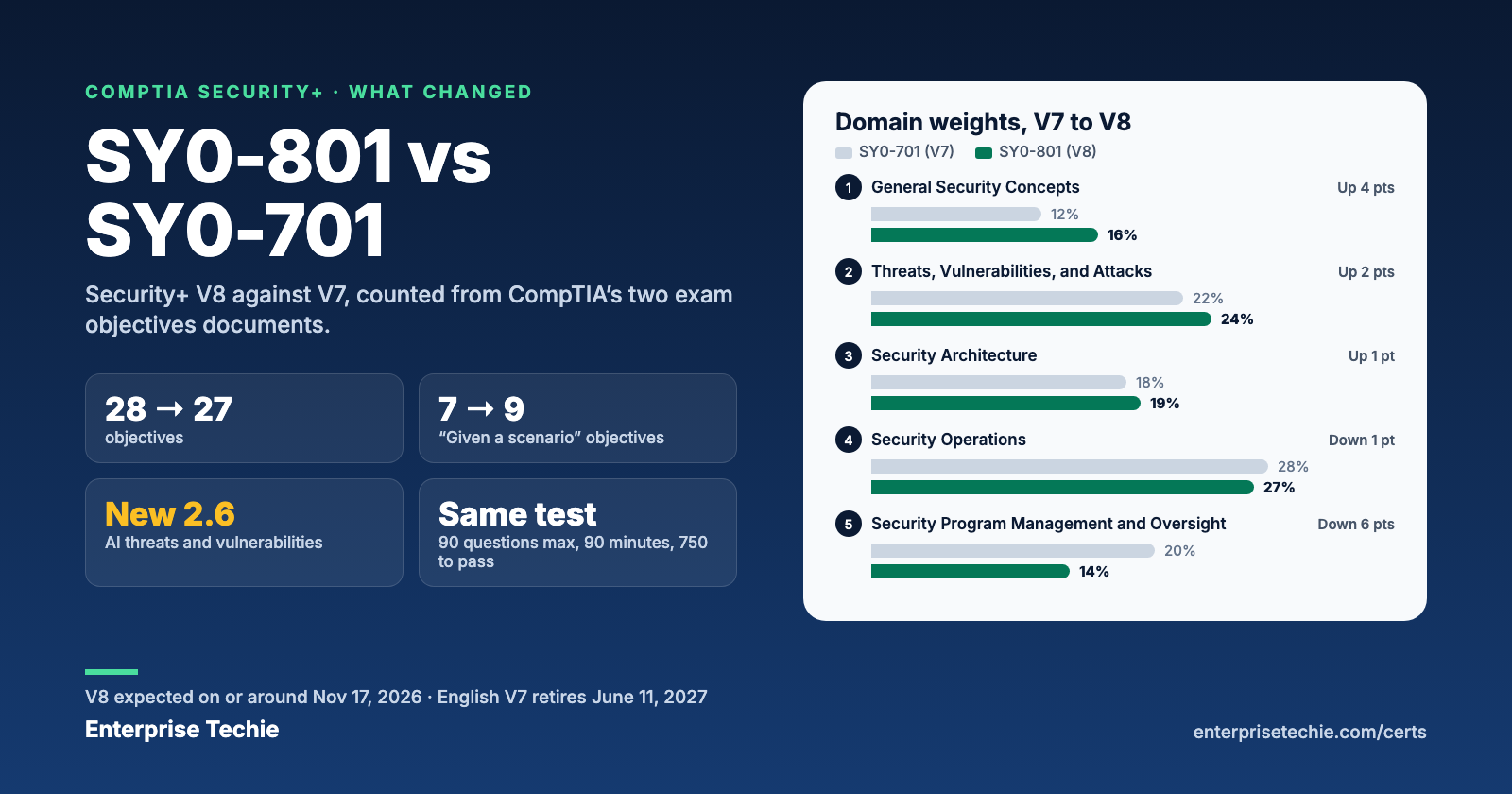
CompTIA is replacing Security+ SY0-701 (V7) with SY0-801 (V8). On the surface, little moves: there are still five domains, a maximum of 90 questions, 90 minutes on the clock and a passing score of 750. Underneath, the content is reorganized. The 28 objectives become 27, every domain weight changes, Domain 2 gets a new name, and a new objective covers the threats and weaknesses that come with using AI.
This page puts the two exam objectives documents side by side: test details, weights, where each SY0-701 objective lands in SY0-801, new and dropped topics, and the dates that decide which exam can be booked. Every fact comes from CompTIA: the Security+ V8 page and its SY0-801 exam objectives (document version 2.0), the SY0-701 V7 exam objectives (document version 7.0), and the Security+ V7 and Security+ pages.
In this guide
SY0-801 vs SY0-701 at a glance
| Detail | SY0-701 (V7) | SY0-801 (V8) |
|---|---|---|
| Launch | November 7, 2023 | Expected on or around November 17, 2026 |
| Retirement | English: June 11, 2027. Japanese, Portuguese, Spanish and Thai: August 13, 2027 | Estimated three years after launch |
| Number of questions | Maximum of 90 | Maximum of 90 |
| Question types | Multiple-choice and performance-based | Multiple-choice and performance-based |
| Length | 90 minutes | 90 minutes |
| Passing score | 750 on a scale of 100 to 900 | 750 on a scale of 100 to 900 |
| Recommended experience | Network+ and two years in a security or systems administrator role (V7 page) | Two years of hands-on experience as a security administrator |
| Languages | English, Japanese, Portuguese, Spanish and Thai | English |
| Domains | 5 | 5 |
| Objectives | 28 | 27 |
| “Given a scenario” objectives | 7 | 9 |
| Objectives document | Version 7.0 | Version 2.0 |
The format of the test does not change, but the recommended background does. The SY0-701 objectives ask for at least two years of IT administration with a security focus, and CompTIA’s V7 page pairs two years in a security or systems administrator role with Network+. For SY0-801, CompTIA recommends two years of hands-on experience as a security administrator, and that line no longer names Network+.
The skills summary at the top of each document grows from four areas to five; the new one is about understanding and applying mitigation techniques. Both documents state that the exam is accredited to the ISO 17024 standard.
Domains and weights, side by side
Both versions use five domains in the same order. The table shows each domain’s share of the exam and its number of objectives, counted from the two documents.
| Domain | SY0-701 weight | SY0-801 weight | Change | Objectives, SY0-701 to SY0-801 |
|---|---|---|---|---|
| 1.0 General Security Concepts | 12% | 16% | Up 4 points | 4 to 3 |
| 2.0 Threats, Vulnerabilities, and Mitigations (SY0-701), renamed Threats, Vulnerabilities, and Attacks (SY0-801) | 22% | 24% | Up 2 points | 5 to 6 |
| 3.0 Security Architecture | 18% | 19% | Up 1 point | 4 to 4 |
| 4.0 Security Operations | 28% | 27% | Down 1 point | 9 to 8 |
| 5.0 Security Program Management and Oversight | 20% | 14% | Down 6 points | 6 to 6 |
| Total | 100% | 100% | 28 to 27 |
The biggest move is in Domain 5, which drops from 20 to 14 percent of the exam. Domain 1 gains the most, from 12 to 16 percent. Security Operations stays the heaviest domain at 27 percent, and Domains 2 and 4 together rise from 50 to 51 percent.
Only one domain is renamed. Domain 2 changes from Threats, Vulnerabilities, and Mitigations to Threats, Vulnerabilities, and Attacks, and the new name matches what happened to its content. The SY0-701 objective on mitigation techniques (2.5) leaves the domain for Security Operations, and Domain 2 gains two new objectives: one on the characteristics of threats and vulnerabilities, and one on AI.
How 28 objectives became 27
Two objectives are new in SY0-801 (2.1 and 2.6), and three SY0-701 objectives no longer stand on their own: 1.2 is folded into 1.1, and 2.5 and 4.5 are merged into the new 4.1. Most of the others are renumbered, and several change their opening verb.
The opening verb signals the kind of knowledge an objective calls for. Three objectives become scenario-based in SY0-801: change management (1.2), vulnerability management (4.3), and automation and orchestration (4.6). Two SY0-701 scenario objectives (4.1 and 4.5) merge into one, so the count of objectives that open with “Given a scenario” goes from seven to nine.
| SY0-701 objective | SY0-801 objective | What changed |
|---|---|---|
| 1.1 Types of security controls | 1.1 Security concepts and controls | Merged with SY0-701 1.2 |
| 1.2 Fundamental security concepts | 1.1, with parts in 3.2, 4.1 and 5.5 | Folded in and spread out |
| 1.3 Change management | 1.2 | Renumbered; now scenario-based |
| 1.4 Cryptographic solutions | 1.3 | Renumbered; same title |
| None | 2.1 Characteristics of threats and vulnerabilities | New |
| 2.1 Threat actors and motivations | 2.2 | Renumbered; verb changes to describe |
| 2.2 Threat vectors and attack surfaces | 2.3 Threat vectors and sources | Split: attack surfaces join 2.4 |
| 2.3 Types of vulnerabilities | 2.4 Vulnerabilities and attack surfaces | Renumbered and widened |
| 2.4 Indicators of malicious activity | 2.5 | Renumbered; same title; still scenario-based |
| 2.5 Mitigation techniques | 4.1 | Moved to Domain 4 and merged |
| None | 2.6 AI threats and vulnerabilities | New |
| 3.1 Architecture models | 3.1 | Same number and title |
| 3.2 Securing enterprise infrastructure | 3.2 | Reworded; still scenario-based |
| 3.3 Protecting data | 3.3 | Verb changes from compare and contrast to summarize |
| 3.4 Resilience and recovery | 3.4 | Same number and title |
| 4.1 Security techniques for computing resources | 4.1 Mitigating controls and solutions | Merged with SY0-701 2.5 and 4.5; still scenario-based |
| 4.2 Asset management | 4.2 | Same number and title |
| 4.3 Vulnerability management | 4.3 | Now scenario-based |
| 4.4 Alerting and monitoring | 4.4 | Same number and title |
| 4.5 Modifying enterprise capabilities | 4.1 | Merged |
| 4.6 Identity and access management | 4.5 | Renumbered; still scenario-based |
| 4.7 Automation and orchestration | 4.6 | Renumbered; now scenario-based |
| 4.8 Incident response | 4.7 | Renumbered; verb changes to summarize |
| 4.9 Data sources for investigations | 4.8 | Renumbered; still scenario-based |
| 5.1 Security governance | 5.1 Governance, risk and compliance artifacts | Reworded |
| 5.2 Risk management process | 5.2 | Reworded |
| 5.3 Third-party risk | 5.3 | Reworded |
| 5.4 Security compliance | 5.4 | Same number and title |
| 5.5 Audits and assessments | 5.5 | Reworded |
| 5.6 Security awareness | 5.6 | Reworded; still scenario-based |
Domain 1: General Security Concepts (12% to 16%)
Fewer objectives, more weight: three objectives instead of four, carrying 16 percent of the exam instead of 12.
- Controls and concepts in one objective. SY0-801 1.1 combines the control categories and types with the core ideas that had their own SY0-701 objective: CIA, AAA, non-repudiation, Zero Trust principles and least privilege. Defense in depth is now named, and the control categories carry paired names such as technical or logical and physical or environmental.
- Concepts that moved out. Zero Trust as an architecture now sits in 3.2, described through user authentication, device health and inventory, and application access control. Deception technology (honeypots, honeynets, honeyfiles, honeytokens) goes to 4.1, and gap analysis to 5.5. The SY0-701 control-plane and data-plane vocabulary, such as the policy engine and the policy enforcement point, is not listed in SY0-801.
- Physical security controls. SY0-701 listed bollards, fencing, lighting, security guards and sensor types such as infrared and ultrasonic. None of these appears in the SY0-801 document. Physical access shows up instead as threat vectors in 2.3 (lock and key, access vestibules, access passes) and as attacks in 2.5 (tailgating, forced entry).
- Change management becomes a scenario objective. It also adds the change advisory board and the idea of failing forward alongside backout planning.
- Cryptography keeps its title but names fewer tools. SY0-801 1.3 no longer lists TPM, HSM, key management systems, secure enclaves, steganography, key stretching, blockchain or the open public ledger. It adds hashing algorithms and encryption protocols as named items.
Study note: material written for SY0-701 splits these fundamentals across two objectives; SY0-801 groups them into one.
Domain 2: Threats, Vulnerabilities, and Attacks (22% to 24%)
The renamed domain grows from five objectives to six and from 22 to 24 percent of the exam. Mitigations leave; threat characteristics and AI arrive.
- New 2.1: characteristics of threats and vulnerabilities. Threat feeds and intelligence sources, likelihood and impact, the threat life cycle, and how vulnerabilities are scored and prioritized with CVSS and CVE. In SY0-701, CVSS, CVE and threat feeds sat under vulnerability management (4.3).
- Threat actors (now 2.2). Nation-state becomes state-sponsored, and terrorists, competitors and accidental or unintentional actors join the list. Shadow IT leaves the actor list and reappears as an attack surface in 2.4. New motivations include influence, intellectual property, notoriety, extortion and general curiosity.
- Threat vectors (now 2.3) get a much longer list. New entries include advanced persistent threats, RCS and collaboration tools, QR codes, malicious attachments, browser extensions and session tokens, living-off-the-land tools, SaaS and logistics providers, IoT and OT devices, and signals such as RF and NFC. The social engineering techniques move to 2.5.
- Vulnerabilities and attack surfaces (now 2.4). The attack-surface half of SY0-701 2.2 joins the vulnerability list. New entries include hardcoded secrets, unsafe exception handling, obsolete and unmanaged systems, stale credentials, rogue devices, low-powered wireless communications, large language models, identity providers, public code repositories and public object storage. SQL injection, cross-site scripting, memory injection, VM escape and side loading are no longer spelled out.
- Indicators of malicious activity (now 2.5). Same title and still scenario-based, with a new social engineering group (phishing, spear phishing, whaling, smishing, vishing, quishing, impersonation and deepfakes) and credential attacks that now include user enumeration and MFA bypass. New physical attacks are tailgating, shoulder surfing, skimming and forced entry, and new network attacks include sniffing, spoofing and cache poisoning. The indicators are now framed as indicators of compromise, such as hashes, malicious processes, log manipulation and plaintext strings. Bloatware, RFID cloning and the collision and birthday attacks are no longer listed.
- New 2.6: AI threats and vulnerabilities. Covered in the section on new topic areas below.
Study note: SY0-701 placed social engineering under threat vectors. SY0-801 places it under indicators of malicious activity, the scenario objective, so practice recognizing each technique from a short description of what happened.
Domain 3: Security Architecture (18% to 19%)
Four objectives in both versions, with content reshuffled between them and between domains.
- Architecture models (3.1). Same number and title. Cloud now includes multicloud and four deployment models: public, private, hybrid and community. OT appears as its own item, and the separate ICS/SCADA, RTOS and embedded-system entries are gone. Considerations are split into technical and business groups. Containerization and software-defined networking are no longer listed.
- Protecting infrastructure (3.2). Still scenario-based. It adds Zero Trust architecture, Security Service Edge, out-of-band management, end-to-end encrypted messaging, file transfer, Group Managed Service Accounts, least privilege access accounts and privilege creep. Firewall types and 802.1X move to 4.1. SASE, SD-WAN, next-generation firewalls, jump servers and EAP are no longer listed, and TLS and IPSec are no longer named in the bullets, although both remain in the SY0-801 acronym list.
- Data protection (3.3). The verb changes to summarize, and the list grows: structured and unstructured data, secret and top secret classifications, data roles (owner, custodian, steward, operator, controller, subprocessor) that sat in governance (5.1) in SY0-701, data handling such as marking, labeling and geofencing, a data life cycle from creation to disposal, compliance categories such as health, financial and child or minor data, and the methods filtering, data transpose and deidentification.
- Resilience and recovery (3.4). Same title. RTO, RPO, MTTR and MTBF move here from the SY0-701 risk objective (5.2). Backups add retention, immutability, scope and restoration testing; power adds redundant power supplies and surge protectors; autoscaling, disaster recovery and business continuity are named. Geographic dispersion, replication and journaling are no longer listed, and tabletop exercises move to incident response preparation (4.7).
Study note: the recovery metrics are still listed. In SY0-801 they belong to resilience and recovery (3.4) rather than to business impact analysis under risk management (5.2).
Domain 4: Security Operations (28% to 27%)
Still the heaviest domain, now with eight objectives instead of nine, five of them scenario-based (four in SY0-701).
- Mitigating controls (4.1). One scenario objective brings together SY0-701 2.5 (mitigation techniques), 4.1 (security techniques for computing resources) and 4.5 (enterprise capabilities). New items include deception technology with canary accounts, rate limiting, wireless intrusion prevention, captive portals and endpoint posture checks, secrets scanning in code repositories, and BIMI. Several SY0-701 items, such as WPA3, RADIUS and DNS filtering, are no longer listed (see the table below).
- Asset management (4.2). Same title, with an asset management life cycle and a planning and scoping step added.
- Vulnerability management (4.3). Becomes scenario-based. Identification adds IP address management, cloud security posture management and source code review, and prioritization uses severity assessment and penetration test report review. OSINT, the dark web, false positives and negatives, exposure factor and insurance are no longer listed.
- Alerting and monitoring (4.4). Same title. It adds syslog, port mirroring, packet analyzers, orchestration, automated alerts and network management systems.
- Identity and access management (now 4.5). Adds account types (user, privileged, service, third-party and emergency access), one-time passwords and backup codes as MFA methods, just-in-time access as an access control model, access reviews, passkeys and compromised credential monitoring. Attribute-based access control, the something-you-know, have and are factor list, password vaulting and ephemeral credentials are no longer listed.
- Automation and orchestration (now 4.6). Becomes scenario-based and adds AI capabilities (agentic AI, chatbots, predictive analysis and AI-augmented baselines), desired state management, anomaly detection and process risks.
- Incident response (now 4.7). Organized as phases from preparation to post-incident activities. New items include roles, internal and external advisories, negotiation, and notification and external reporting to stakeholders, customers and law enforcement, including mandatory reporting. Legal hold moves to compliance (5.4).
- Investigation data (now 4.8). Still scenario-based, with more log types, IPFIX, surveillance footage, system images such as memory dumps and bit-level copies, HR and legal as stakeholders, and log-parsing techniques.
Study note: the new 4.1 absorbs three SY0-701 objectives, so topics from segmentation and firewalls to EDR and email authentication now sit under one scenario objective.
Domain 5: Security Program Management and Oversight (20% to 14%)
The domain keeps all six objectives but loses six percentage points, the largest drop on the exam. Several objectives are reworded, and some content moves to Domain 3.
- Governance, risk and compliance artifacts (5.1). Organized into guidelines, standards, procedures, plans and policies. New items include benchmarks, advisories, runbooks, RFCs, and policies such as clean desk and vulnerability disclosure. The governance structure types and the SDLC policy are no longer listed, and data roles move to 3.3.
- Risk management (5.2). Adds residual risk, stakeholder ownership, current mitigations and management oversight. Recovery metrics move to 3.4. Exposure factor, key risk indicators, risk tolerance and risk threshold, and the expansionary, conservative and neutral appetite labels are no longer listed. SLE, ALE and ARO stay.
- Third-party risk (5.3). Adds RFP, RFI, RFQ and expression of interest, service-level objectives, a vendor registry, and constraints such as vendor lock-in, jurisdiction and return on investment. Business partners agreements and work orders are no longer listed.
- Security compliance (5.4). Same title. Adds compliance training (data handling, AML/CTF, anti-bribery), legal compliance (legal hold, legal orders, data retention requirements) and more privacy rights, such as opt-in or opt-out, data correction and processing restrictions.
- Audits and assessments (5.5). Adds data gathering (sampling, interviews, questionnaires) with MITRE ATT&CK, the Cyber Kill Chain and the Diamond Model as reference sources, audit charters, gap analysis, benchmarking, frameworks and standards, and functional and behavioral testing.
- Security awareness (5.6). Still scenario-based, now organized around training types (onboarding, ongoing, targeted, corrective), delivery methods, effectiveness reporting including personnel behavior risk scoring, and topics such as BEC and BYOD. The SY0-701 phishing campaign and anomalous behavior items are no longer listed.
Study note: agreement types, vendor selection documents and the SLE, ALE and ARO arithmetic are all still listed.
New topic areas in SY0-801
CompTIA’s Security+ page describes V8 as offering expanded coverage of AI-related risks, security operations and modern environments. In the objectives, the additions cluster into a handful of themes.
- AI, on both sides. Objective 2.6 covers model manipulation, poisoning, prompt injection, jailbreaking, evasion and hallucinations, along with data loss, privacy, bias, explainability, ethical considerations, and the session hijacking and code execution risks of AI use. AI also appears as an attack surface (large language models in 2.4), as a social engineering tool (deepfakes in 2.5) and as a defensive capability (agentic AI, chatbots, predictive analysis and AI-augmented baselines in 4.6). No SY0-701 objective mentions AI, although AI appears in the SY0-701 acronym list.
- Beyond AI. Identity gains passkeys, Group Managed Service Accounts, privilege creep and identity providers as an attack surface. Cloud and SaaS bring Security Service Edge, cloud security posture management and public object storage. Code brings hardcoded secrets and secrets scanning, email authentication gains BIMI, social engineering gains quishing, and incident response gains negotiation.
Several of the 2.6 terms are easy to blur, and NIST AI 100-2 E2025 separates them by when the attack happens. Poisoning takes place during training, for example when an attacker controls part of the training data. Evasion targets a model that is already deployed, with inputs altered to change its predictions. In the NIST glossary, prompt injection exploits untrusted input placed into a prompt built by a more trusted party, and a jailbreak is a direct prompting attack meant to get around restrictions on a model’s outputs. The Security+ SY0-801 study guide covers each one in its section on objective 2.6.
Topics SY0-801 no longer lists
Both documents say their bulleted lists are not exhaustive and that related topics can appear on the exam even when unlisted, so a missing topic is not a promise that it will never be tested. Each item below appears in the SY0-701 objectives and nowhere in the SY0-801 document, acronym list included.
| No longer listed | Where SY0-701 listed it |
|---|---|
| Blockchain and the open public ledger | 1.4 |
| Key stretching and steganography | 1.4 |
| TPM, HSM and secure enclaves | 1.4 |
| Bollards, fencing, lighting and security guards | 1.2 |
| Infrared, pressure, microwave and ultrasonic sensors | 1.2 |
| Zero Trust control-plane and data-plane terms such as the policy engine and policy enforcement point | 1.2 |
| Typosquatting, pretexting, brand impersonation, misinformation and disinformation | 2.2 |
| Cross-site scripting, memory injection, VM escape and side loading | 2.3 |
| Bloatware, RFID cloning, and collision and birthday attacks | 2.4 |
| ICS/SCADA, RTOS, containerization and software-defined networking | 3.1 |
| SASE, SD-WAN, next-generation firewalls, jump servers and EAP | 3.2 |
| WPA3, RADIUS, COPE and CYOD, site surveys and heat maps | 4.1 |
| OSINT and the dark web as threat feeds, exposure factor | 4.3 (exposure factor also in 5.2) |
| DNS filtering, screened subnets and user behavior analytics | 4.5 |
| Attribute-based access control, password vaulting and ephemeral credentials | 4.6 |
| Key risk indicators and the expansionary, conservative and neutral risk appetite labels | 5.2 |
| Business partners agreements and work orders | 5.3 |
Key dates
- November 7, 2023: SY0-701 launched.
- On or around November 17, 2026: SY0-801 is expected to launch.
- June 11, 2027: the English SY0-701 exam retires.
- August 13, 2027: the Japanese, Portuguese, Spanish and Thai SY0-701 exams retire.
- SY0-801 retirement: estimated at three years after launch.
If the dates hold, the two English exams overlap for almost seven months.
Which exam to take: SY0-701 or SY0-801
The dates settle most of the question. Until SY0-801 launches, SY0-701 is the only Security+ exam on offer. From the SY0-801 launch until June 11, 2027, both versions are available in English. After that date the English SY0-701 exam is retired, and the other four SY0-701 languages follow on August 13, 2027. CompTIA’s V8 page lists only English for SY0-801.
The second factor is study material. The two exams are built from different objective lists, so material written for one code does not line up exactly with the other: SY0-801 adds objectives such as 2.1 and 2.6, stops naming the topics listed above, and weights the domains differently. Whichever exam is booked, the study material should name the same exam code as the voucher.
For SY0-801, the SY0-801 exam objectives explained page walks through all 27 objectives in plain English, and the Security+ SY0-801 study guide teaches them domain by domain.
Practice against the SY0-801 objectives
Try 30 free Security+ practice questions with answers and explanations, plus a 10-question quick check scored at the end. No sign-up.
Frequently asked questions
What is the difference between SY0-701 and SY0-801?
SY0-801 is the newer Security+ exam (V8). It keeps five domains but has 27 objectives instead of 28, renames Domain 2 to Threats, Vulnerabilities, and Attacks, shifts weight from Domain 5 to Domain 1, and adds an objective on AI threats and vulnerabilities.
When does SY0-701 retire?
CompTIA lists June 11, 2027 for the English SY0-701 exam and August 13, 2027 for the Japanese, Portuguese, Spanish and Thai versions.
When does Security+ SY0-801 launch?
CompTIA expects Security+ V8 to launch on or around November 17, 2026. Its retirement is estimated at three years after launch.
Did the number of questions or the passing score change?
No. Both versions have a maximum of 90 multiple-choice and performance-based questions, a 90-minute limit and a passing score of 750 on a scale of 100 to 900.
What is new in Security+ SY0-801?
Two new objectives: 2.1 on the characteristics of threats and vulnerabilities, and 2.6 on threats and vulnerabilities associated with AI. New named topics include passkeys, Security Service Edge, BIMI, secrets scanning, deepfakes, quishing, negotiation in incident response, and the MITRE ATT&CK, Cyber Kill Chain and Diamond Model references.
Is SY0-801 harder than SY0-701?
CompTIA’s Security+ pages and objectives documents do not compare the difficulty of the two versions. What the documents show is that SY0-801 has nine scenario-based objectives against seven in SY0-701, with the same question limit, time and passing score.
Can SY0-701 study material be used for SY0-801?
Not on its own. SY0-801 adds objectives and topics that SY0-701 material does not cover, such as the AI objective 2.6, and it weights the domains differently. Material written to the SY0-801 objectives matches the new exam.
What languages is SY0-801 available in?
CompTIA’s Security+ V8 page lists English. SY0-701 is offered in English, Japanese, Portuguese, Spanish and Thai until its retirement dates.
Sources: CompTIA Security+ V8 (SY0-801) and its exam objectives, document version 2.0; CompTIA Security+ V7 (SY0-701) and its exam objectives, document version 7.0; CompTIA Security+. Objective counts, term comparisons and weight changes are counted from the two objectives documents. Last checked: November 2026. CompTIA and Security+ are trademarks of CompTIA, Inc. Enterprise Techie is not affiliated with or endorsed by CompTIA.