These 30 free CompTIA Security+ SY0-801 practice questions each come with the answer and an explanation. Start with the quick check: ten questions drawn at random and scored at the end. All 30 questions follow, with the answers hidden until opened.
The questions come from the Enterprise Techie question bank. Every question is written to the SY0-801 exam objectives and checked in a separate review against primary sources such as NIST, IETF, CISA and MITRE. They are original practice questions, not questions from the real exam. For the material behind them, see the Security+ study guide.
On this page
What’s changing
Checked against CompTIA’s pages on November 15, 2026.
- On or around November 17, 2026: CompTIA expects to launch SY0-801 (V8), in English (CompTIA).
- June 11, 2027: SY0-701 (V7) retires in English. Japanese, Portuguese, Spanish and Thai follow on August 13, 2027 (CompTIA).
What the new version changes: SY0-801 vs SY0-701. Key dates and which version to take: Security+ SY0-801 launch and SY0-701 retirement dates.
For every upcoming exam date, see the IT certification exam calendar.
Take the 10-question quick check
Free quick check · CompTIA Security+ SY0-801
10 random questions, scored at the end
Ten questions drawn at random from the 30 below. Each answer shows the explanation, and the score at the end can be shared. Nothing is saved and there is no sign-up.
All 30 Security+ practice questions with answers
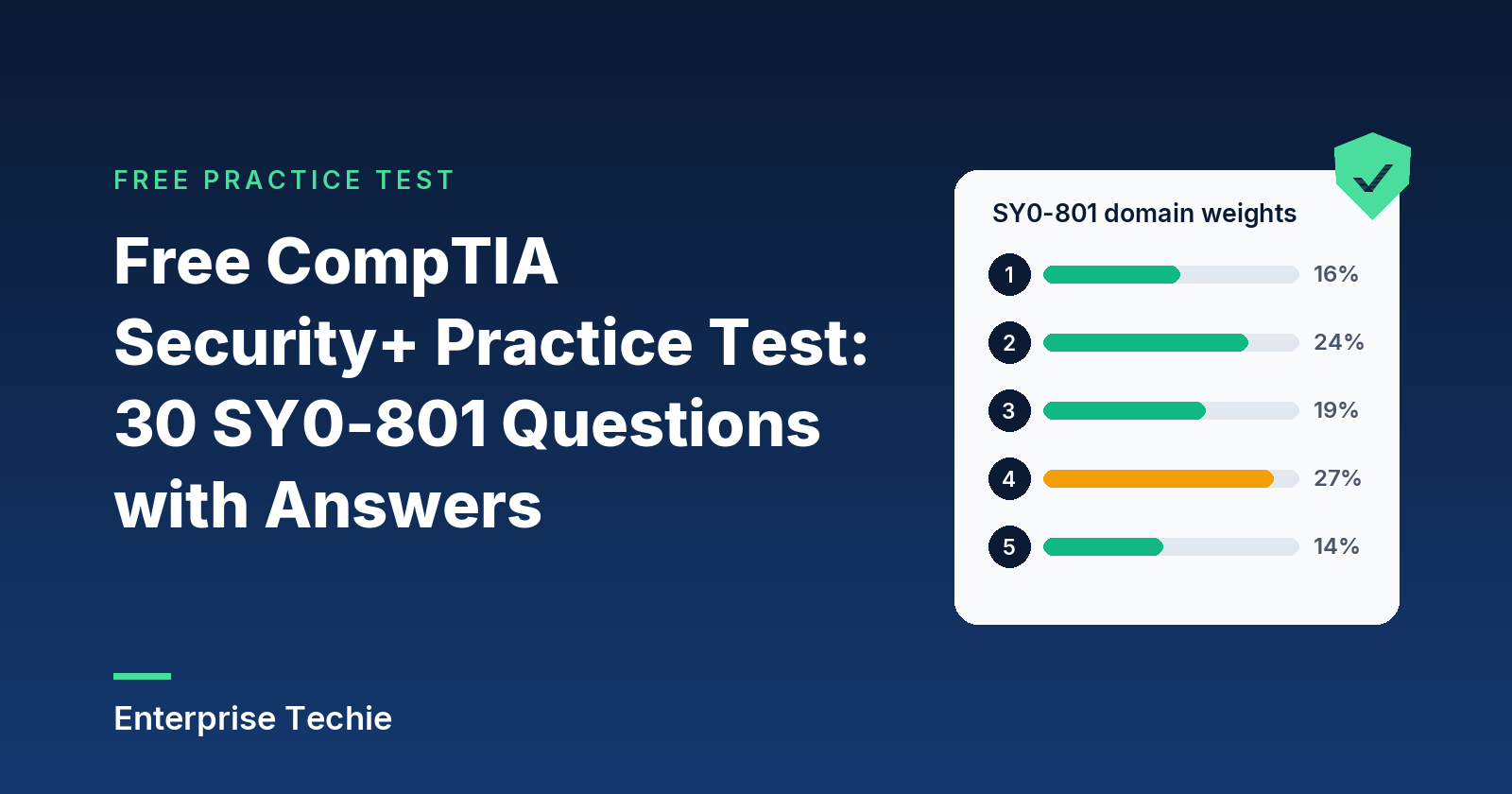
The 30 questions cover all 5 exam domains. Open an answer to see the explanation.
| Domain | Questions here |
|---|---|
| General Security Concepts | 5 |
| Threats, Vulnerabilities, and Attacks | 7 |
| Security Architecture | 6 |
| Security Operations | 8 |
| Security Program Management and Oversight | 4 |
A phishing email slips past a company's email gateway and a user opens the attachment. Endpoint protection then blocks the payload from running, and egress filtering would have stopped its callback anyway. Which principle does this outcome illustrate?
- Least privilege, where each account holds only the rights it needs
- Defense in depth, where multiple layered controls back one another up
- Separation of duties, where no one person completes a sensitive task
- Non-repudiation, where actions can be proven against whoever took them
Show the answer
Answer: B. B is right: NIST describes defense in depth as integrating people, technology and operations capabilities into layered barriers, so a threat missed by one layer (the email gateway) is caught by another (endpoint protection, egress filtering). A limits account rights, which is not what stopped the payload. C splits sensitive tasks between people. D is about proving who performed an action, not about stopping an attack.
An attacker gains write access to a file server and quietly changes the bank account numbers in several vendor payment files. Nothing is deleted and no data leaves the network. Which security goal did the attacker primarily violate?
- Confidentiality
- Integrity
- Availability
- Accounting
Show the answer
Answer: B. B is the goal violated: FIPS 200 defines integrity as guarding against improper information modification or destruction, and the attacker altered payment data. A would be the main concern if the files had been read or exfiltrated, which the scenario rules out. C concerns timely and reliable access, and the files stayed accessible. D is the logging function of AAA, not one of the CIA security goals.
A RADIUS server records when each VPN session starts and stops and how much data it transferred. The security team later uses those records to investigate unusual usage. Which part of AAA do these records represent?
- Authentication
- Authorization
- Accounting
- Attestation
Show the answer
Answer: C. C is right: RFC 2989 defines accounting as collecting information on resource usage for trend analysis, auditing, billing or cost allocation, which is what session start, stop and byte counts are. A verifies a claimed identity before the session begins. B decides whether the authenticated user may have a particular right or resource. D is not one of the three AAA functions; it refers to vouching for the state of a device or software.
Two companies protect purchase orders exchanged over an API with an HMAC computed using a secret key they both hold. In a dispute, one company claims it never sent a particular order. Why can't the HMAC settle the dispute?
- An HMAC protects only confidentiality, so it reveals nothing about who created a message
- Either party could have computed the HMAC, so it cannot show which one created the order
- An HMAC cannot detect changes to a message, so the order may have been altered in transit
- An HMAC must be validated by a certificate authority, and neither company operates one
Show the answer
Answer: B. B is right: a MAC gives data integrity and source authentication between the key holders, but because the key is shared, a third party cannot tell which holder produced it. NIST SP 800-175B notes that digital signatures, made with a private key held only by the signer, are what support non-repudiation. A is wrong because a MAC provides integrity and authentication, not confidentiality. C is wrong because detecting modification is exactly what a MAC does. D is wrong because HMAC verification uses the shared secret key, not a certificate authority.
Under a Zero Trust design, a user's laptop is plugged into the wired network inside headquarters. When the user requests access to the HR application, how should the request be treated?
- It can get lighter checks because the device is already inside the corporate perimeter
- It can be allowed automatically if the user signed in to another internal app that day
- It must first be routed through the VPN, because only VPN traffic is evaluated by policy
- It must pass the same authentication and authorization checks as a request from outside
Show the answer
Answer: D. D reflects the NIST SP 800-207 tenet that network location alone does not imply trust: requests from assets on enterprise-owned infrastructure must meet the same security requirements as requests from any other network. A is the implicit perimeter trust that Zero Trust rejects. B conflicts with the tenet that authentication and authorization to one resource does not automatically grant access to a different resource. C is wrong because Zero Trust evaluates every request by policy regardless of how it arrives.
A scanner reports a CVSS-B score of 9.3 for a flaw on a file server. Current threat intelligence shows no public proof-of-concept code and no reported attempts to exploit the flaw, and the team wants the score to reflect that. Which CVSS v4.0 metric group should the team complete?
- Threat metrics, which record how mature the available exploit code currently is
- Supplemental metrics, which add context such as Automatable, Safety and Recovery
- Base metrics, which each consumer rescores to fit the details of their deployment
- Environmental metrics, covering security requirements and modified Base values
Show the answer
Answer: A. A is correct: the CVSS v4.0 Threat group holds a single metric, Exploit Maturity, which the consumer sets from threat intelligence; Unreported (no public proof-of-concept and no reported attacks) lowers the score, while the default, Not Defined, is scored as Attacked. B is wrong because Supplemental metrics add context but never change the calculated score. C is wrong because Base metrics are intrinsic and constant across environments. D is wrong because Environmental metrics reflect the consumer's own asset importance and controls, not the state of exploitation.
A patch team can remediate only one of two findings this week. Finding 1 is CVSS 9.1 on an internal lab server with no known exploitation and no internet exposure. Finding 2 is CVSS 7.5 on an internet-facing VPN appliance, and its CVE is in CISA's Known Exploited Vulnerabilities catalog. Which choice follows CISA's risk-based prioritization approach?
- Fix Finding 1 first, since its higher base score indicates the greater risk
- Fix Finding 2 first, since it is publicly exposed and is known to be exploited
- Fix neither until both CVEs pass the same EPSS probability threshold
- Fix Finding 1 first, since internal servers are likelier to hold sensitive data
Show the answer
Answer: B. B is correct: CISA BOD 26-04 weighs asset exposure, KEV status, exploit automation and technical impact, so an internet-facing asset with confirmed exploitation outranks a higher-scored but unexposed, unexploited one. A is wrong because a CVSS base score measures severity, not whether a flaw is exposed or being exploited. C is wrong because waiting on another score delays action on a confirmed, exploited exposure. D is wrong because an assumption about data location does not outweigh exposure and active exploitation.
A code review report cites CWE-89, while the vendor's advisory for the same product cites a CVE ID. What is the difference between the two identifiers?
- CWE assigns a severity score; a CVE ID describes the exploit code that attackers use
- CWE names a type of weakness; a CVE ID names one specific disclosed vulnerability
- CWE lists affected product versions; a CVE ID names the weakness category
- CWE tracks exploitation in the wild; a CVE ID is a private vendor ticket number
Show the answer
Answer: B. B is correct: CWE is a community-developed list of software and hardware weakness types (CWE-89 is SQL injection), while CVE IDs, assigned by CVE Numbering Authorities, identify specific publicly disclosed vulnerabilities. A is wrong because severity comes from CVSS and a CVE record is not exploit code. C reverses the roles. D is wrong because exploitation tracking is the job of sources such as CISA's KEV catalog, and CVE IDs are public.
An ISAC partner shares an incident report marked TLP:AMBER+STRICT. Your company's managed security provider asks for a copy so it can tune detections. Under FIRST TLP 2.0, what may you do?
- Share it with the provider, because AMBER covers clients and service partners
- Post it to the ISAC's public portal, since the partner has already released it
- Share it only within your own organization and decline the provider's request
- Share it across your sector community, because the report is not marked RED
Show the answer
Answer: C. C is correct: TLP:AMBER+STRICT restricts sharing to the recipient organization only. A is wrong because plain AMBER extends only to the organization and its clients, and the STRICT qualifier removes even that. B describes TLP:CLEAR, which has no limit on disclosure. D describes TLP:GREEN, which allows sharing within a community.
A SOC wants to ingest an ISAC's threat feed automatically, receiving indicators in a standard machine-readable structure delivered over an API. Which two standards fit this requirement? (Choose two.)
- STIX, a structured language for describing cyber threat intelligence
- CVSS, a framework for rating the technical severity of vulnerabilities
- SAML, an XML standard for exchanging authentication and authorization data
- TAXII, a transport protocol for exchanging threat intelligence over HTTPS
Show the answer
Answers: A and D. A and D are correct: STIX defines how threat intelligence is structured and TAXII defines how it is transported between producers and consumers, which together allow automated ingestion. B is wrong because CVSS scores vulnerability severity and does not carry indicators. C is wrong because SAML supports federated sign-on, not threat sharing.
During a risk assessment, an analyst records two facts: a highly capable ransomware group has recently targeted three hospitals in the region, and the hospital's immutable backups would limit any outage to about two hours. How should these facts be applied in a NIST SP 800-30 style assessment?
- Both facts lower the likelihood rating, because tested backups deter attackers
- The group's capability and targeting raise likelihood; the backups limit impact
- The group's targeting raises impact, while the backups lower the likelihood rating
- Both facts raise the impact rating, because hospital outages bring fines and harm
Show the answer
Answer: B. B is correct: SP 800-30 bases the likelihood of an adversarial threat event on intent, capability and targeting, and defines impact as the magnitude of harm, which effective backups reduce by shortening the loss of availability. A is wrong because a capable group actively targeting peers increases, not decreases, likelihood. C reverses the two factors. D is wrong because capability and targeting describe the adversary, which feeds likelihood rather than impact.
A database administrator who was passed over for promotion schedules a script to delete customer records on his last day of employment. Which motivation best describes this action?
- Espionage, gathering secrets for a foreign intelligence service
- Revenge, acting on a personal grievance against the employer
- Ethical, exposing a flaw so that the company will correct it
- Financial, extracting a payment in exchange for restoring data
Show the answer
Answer: B. B is correct: CISA describes intentional insiders who act to harm an organization on a personal grievance, which matches sabotage after a missed promotion. A is wrong because nothing points to a foreign service. C is wrong because deleting data does not help fix a flaw. D is wrong because no payment was demanded.
A development team moves an order-processing job from a virtual machine it patched itself to a public cloud provider's serverless function platform. Under the shared responsibility model, which task does the team still own?
- Applying security patches to the operating system that the functions run on
- Securing the function code and limiting what its execution role is allowed to access
- Maintaining the physical hosts and hypervisor in the provider's data centers
- Replacing failed network hardware on the links between the provider's availability zones
Show the answer
Answer: B. Serverless functions follow a platform (PaaS) model in which the provider manages the operating system and physical infrastructure, while the customer stays responsible for application code security, configuration, and access controls, so B is correct. A is the provider's job once the OS is part of the managed platform. C and D are physical infrastructure that the provider owns in every cloud service model.
Several regional hospitals that share the same regulatory requirements want a cloud infrastructure provisioned only for their group and operated by a third party. Which NIST cloud deployment model fits this description?
- Public cloud
- Community cloud
- Hybrid cloud
- Private cloud
Show the answer
Answer: B. NIST SP 800-145 defines a community cloud as infrastructure provisioned for exclusive use by a community of organizations with shared concerns, such as compliance, and it may be run by a third party, so B fits. A is provisioned for open use by the general public. C is a composition of two or more distinct cloud infrastructures. D is provisioned for a single organization, not a group of hospitals.
An insurer keeps policyholder records in its own private cloud but sends overflow processing to a public cloud during annual renewal peaks. The two environments stay separate but are linked by technology that lets the workload move between them. How does NIST classify this arrangement?
- A community cloud shared by insurers that have common compliance needs
- A public cloud provisioned for open use by any customer who signs up
- A hybrid cloud that uses cloud bursting between distinct infrastructures
- A private cloud that a third-party provider hosts off the insurer's premises
Show the answer
Answer: C. NIST SP 800-145 defines a hybrid cloud as two or more distinct cloud infrastructures that remain unique entities but are bound by technology enabling data and application portability, and it names cloud bursting as an example, so C is correct. A requires a group of organizations with shared concerns. B describes only the public half of the design. D is still a single private cloud, regardless of who hosts it.
A cloud team deploys all network security groups from version-controlled IaC templates. During an outage, an engineer opens an inbound port through the provider's web console, and the change is never written back to the templates. What is the main security problem this creates?
- The templates now contain credentials that attackers can extract
- The provider will silently revert the console change at the next deployment window
- The pipeline will record the console change as an approved baseline
- The running environment has drifted from the reviewed IaC definitions
Show the answer
Answer: D. NIST SP 800-204C explains that a console or CLI change bypasses IaC, so the deployed architecture no longer matches the reviewed code, and drift must be checked right after deployment and periodically, which makes D the problem. A describes a different IaC weakness, hard-coded secrets, which a port change does not create. B is wrong because cloud consoles do not undo changes on their own; only a later IaC run would overwrite it. C is wrong because the change never passed through the pipeline or its review at all.
During a review, a security analyst finds a database administrator password written in plain text inside a Terraform template stored in the company's Git repository. Which remediation best addresses this finding?
- Make the repository private so that only current employees are able to clone it
- Base64-encode the password so that it no longer appears in plain text
- Rotate the password once, then keep the new value in the template
- Rotate the password, store it in a secrets manager, and reference it from the template
Show the answer
Answer: D. This is a hard-coded credential (CWE-798), and the documented mitigation is to keep credentials outside the code in a protected store; because the old value stays in the commit history, it must also be rotated, and D does both. A narrows the audience but leaves the secret in every clone and in the commit history. B is encoding, not encryption, and anyone can reverse it. C fixes the exposed value once but recreates the same hard-coded weakness.
A utility is connecting the control network for its water treatment plant to corporate IT for monitoring. Which two characteristics of operational technology should shape the security architecture? (Choose two.)
- Confidentiality of sensor readings is normally the top priority for OT system data
- Safety and availability of the physical process usually come before confidentiality
- OT components usually share the three-to-five-year lifetime that IT components have
- Standard IT security tools and patch cycles may disrupt OT systems if applied unchanged
Show the answer
Answers: B and D. NIST SP 800-82r3 states that OT prioritizes safety, followed by availability, integrity, and confidentiality, which supports B, and that IT programs or tools may not be suitable for OT systems, which supports D. A reverses that priority order. C is wrong because NIST puts typical OT component lifetimes at 10 to 15 years or longer, so legacy systems are common.
A company hosts a public web server and an internal HR database on the same flat network. After the web server was compromised, the attacker connected directly to the HR database. Which change would most directly limit this kind of lateral movement in the future?
- Place the web server in a screened subnet, firewalled off from internal networks
- Enable full-disk encryption on both the web server and the HR database host
- Require multifactor authentication for every employee who uses the HR application
- Increase the web server's log retention and forward all of its logs to the SIEM
Show the answer
Answer: A. A is correct: SP 800-53 SC-7 calls for publicly accessible components to sit in subnetworks separated from internal networks, so a compromised public host cannot reach internal systems directly. B protects data at rest on lost or stolen media, not network paths between hosts. C strengthens user sign-in but does nothing about a compromised server connecting to the database. D helps detection and investigation but does not block the connection.
A new Linux server will only serve HTTPS, but a scan shows Telnet, FTP, and a print service listening on it. Applying the principle of least functionality, what should the administrator do?
- Leave the services running but turn on verbose logging for each one
- Disable or remove the unneeded services and close their open ports
- Move the unneeded services to nonstandard port numbers to hide them
- Install a host-based antivirus agent to watch the unneeded services closely
Show the answer
Answer: B. B is correct: least functionality (SP 800-53 CM-7) means configuring a system to provide only essential capabilities and disabling unneeded ports, protocols, and services, which shrinks the attack surface. C is obscurity only, since scanners still find services on other ports. A records activity but leaves the exposure in place. D adds monitoring without removing the vulnerable services.
An email security team wants suspicious attachments opened automatically in an isolated, instrumented environment so their behavior can be observed before the messages are delivered to users. Which technique does this describe?
- Honeypotting
- Tokenization
- Steganalysis
- Sandboxing
Show the answer
Answer: D. D is correct: a sandbox is a restricted, controlled execution environment that keeps potentially malicious code from reaching resources beyond those it is allowed, so its behavior can be watched safely. A uses decoy systems to attract attackers rather than detonating inbound files. B replaces sensitive values with surrogate tokens. C looks for data hidden inside media files.
A security team places a cloud access key in a configuration file on a developer file share. No person or system is meant to use the key, and an alert fires whenever anyone tries to authenticate with it. What is this control called?
- Key escrow
- Honeynet
- Honeytoken
- Secrets vault
Show the answer
Answer: C. C is correct: a honeytoken is a planted credential or data item that nothing legitimately uses, so any attempt to use it signals compromise and shows where it was taken from. B is a network of decoy systems, not a single planted credential. A is a third party holding copies of keys for recovery. D stores and protects real secrets; it is not a lure.
A research team wants to watch how intruders move laterally between servers, workstations, and network devices, without exposing any production systems. Which deception approach best fits this goal?
- A honeynet of several decoy systems that imitate a production network segment
- A sandbox that detonates inbound email attachments before delivery
- A single honeyfile placed in a share on the most sensitive production file server
- A canary account added to the directory with a long, unused password
Show the answer
Answer: A. A is correct: a honeynet is a network of decoys, so attackers can move between systems and their lateral movement can be observed without touching production (SP 800-53 SC-26 decoys). C alerts when a file is opened but shows nothing about movement between hosts, and it sits on production. D detects attempts to use one account, not movement across systems. B analyzes attachments, not intruder behavior inside a network.
A hospital lets clinicians use personal phones for its secure messaging app. The CISO requires that patient data on a lost phone can be removed without erasing the owner's personal photos, and that every phone has a screen lock. Which two MDM capabilities meet these requirements? (Choose two.)
- Selective wipe of the managed work container and its app data
- Disabling the camera on every enrolled personal phone
- Enforcement of a device passcode policy at enrollment
- Full factory reset of the device triggered from the console
Show the answer
Answers: A and C. A and C are correct: enterprise mobility management can wipe only the managed container, leaving personal data alone, and can require a passcode before a device is enrolled (SP 800-124 Rev. 2). D erases the whole phone, including the owner's photos, which the requirement rules out. B restricts a feature but neither removes patient data nor enforces a screen lock.
Finance workstations are getting application allow listing, and standard users can write to the accounting package's install folder. The package gets frequent vendor patches, and the team does not want to edit the allow list after every patch, but users must not be able to run renamed copies of unapproved programs. Which allow-list attribute fits best?
- The folder path where the application is currently installed on disk
- The SHA-256 hash of the currently installed executable file
- The file name of the approved application's main executable
- The publisher identity in the vendor's code-signing signature
Show the answer
Answer: D. D is correct: SP 800-167 notes that a publisher signature lets updated versions from the same vendor run without new rules, while unsigned or differently signed programs stay blocked. B is precise but changes with every patch, so the list would need updating each time. C is defeated by renaming an unapproved program to the approved name. A fails because users can copy any program into that writable folder.
A sensor receives a copy of traffic from a switch mirror port and alerts on exploit signatures, but it cannot stop attacks. Management wants malicious packets dropped before they reach the servers. What change is required?
- Add more signatures so the passive sensor detects additional exploit types
- Increase the mirror port speed so the sensor sees every packet
- Deploy the sensor inline as a network-based intrusion prevention system
- Replace the sensor with host agents that only report to the SIEM
Show the answer
Answer: C. C is correct: SP 800-94 explains that an IPS sits inline so it can block traffic, while a passive IDS only watches a copy and alerts. A improves detection but the sensor still cannot drop anything. D gives host visibility but agents that only report still do not block. B improves visibility on the copy, not the ability to stop packets.
A security architect publishes a document recommending secure coding practices for development teams. Because the teams use different languages and frameworks, the document says each team may meet its intent in whatever way suits its stack, and adherence is encouraged rather than enforced. Which type of governance artifact is this?
- A guideline, because it advises and allows more than one valid implementation
- A standard, because it specifies uniform technologies that every team must use
- A procedure, because it lists the detailed steps for completing one specific task
- A policy, because it sets management's direction and assigns program responsibilities
Show the answer
Answer: A. NIST SP 800-12 Rev. 1 describes guidelines as recognizing that systems vary, so they can be implemented correctly in more than one way, which matches a recommended, non-enforced document. B describes a standard, which is normally compulsory and requires uniform use. C describes a procedure, the detailed steps for a particular task. D describes a policy, the broad management statement from which standards, guidelines, and procedures flow.
An operations team downloads a CIS Benchmark for its server operating system, selects the Level 1 recommendations, documents two approved deviations, and places the resulting settings under configuration control as mandatory for every production server. What has the team produced?
- A reference architecture that describes components without prescribing settings
- A security baseline: mandatory settings derived from the benchmark's guidance
- An implementation guide that shows an example build using commercial products
- A runbook that automates the steps for restoring a server after a failure
Show the answer
Answer: B. SP 800-70 Rev. 4 treats benchmarks, hardening guides, and STIGs as security configuration checklists, which are guidance; once the organization selects settings and makes them mandatory under configuration control, the result is its baseline configuration (SP 800-53 CM-2), which functions as a standard. A is a vendor-neutral conceptual model and contains no device settings. C describes NIST SP 1800 style practice guides, which document example implementations. D is an operational procedure for one task, not a set of required configuration values.
A company is updating its password standard to align with NIST SP 800-63B-4. Which two requirements in the current standard must be removed? (Choose two.)
- Prompt users to set up security questions when they create a password
- Permit passwords as long as 64 characters or more, including spaces
- Check only the first eight characters of a password at sign-in
- Limit the number of failed sign-in attempts allowed on each account
Show the answer
Answers: A and C. SP 800-63B-4 says verifiers and CSPs shall not prompt subscribers to use knowledge-based authentication or security questions when choosing passwords, and that verifiers shall verify the entire submitted password rather than truncate it, so A and C must be removed. B should stay: the guidance says verifiers should permit a maximum password length of at least 64 characters and should accept the space character. D should stay: verifiers shall implement rate limiting that effectively limits failed authentication attempts on an account.
After a regional flood closed a branch for a week, leadership asks for a document describing how payroll and customer service will keep operating during and after a disruption, including manual workarounds, staff relocation, and which processes are restored first. Which plan should be developed?
- A disaster recovery plan focused on restoring information systems at an alternate site
- An incident response plan for detecting, containing, and eradicating cyberattacks
- A business continuity plan focused on sustaining mission and business processes
- A business impact analysis that measures how long each process can be unavailable
Show the answer
Answer: C. SP 800-34 Rev. 1 defines the business continuity plan as the documented instructions for sustaining mission and business processes, such as payroll and customer service, during and after a significant disruption. A is information system focused: the DRP restores systems at an alternate facility and may support the BCP, but it does not cover manual workarounds for business processes. B addresses cybersecurity incidents, not general disruptions such as floods. D is an analysis that feeds the plans by characterizing requirements and priorities; it is not itself an operating plan.
Frequently asked questions
Are these real Security+ exam questions?
No. They are original practice questions written to the SY0-801 exam objectives, not questions taken from the real exam.
How many questions are on the Security+ SY0-801 exam?
A maximum of 90, a mix of multiple-choice and performance-based questions. Candidates get 90 minutes, according to CompTIA's Security+ V8 page.
What is the passing score for Security+ SY0-801?
750 on a scale of 100 to 900, according to CompTIA.
Is the quick check score saved anywhere?
No. The quick check runs in the browser, and nothing is saved or sent. The share buttons create a link that carries only the score.
Sources: the questions come from the Enterprise Techie question bank. Test details are from CompTIA, as cited in the Security+ study guide. Last checked: November 2026. CompTIA and Security+ are trademarks of CompTIA, Inc. Enterprise Techie is not affiliated with or endorsed by CompTIA.