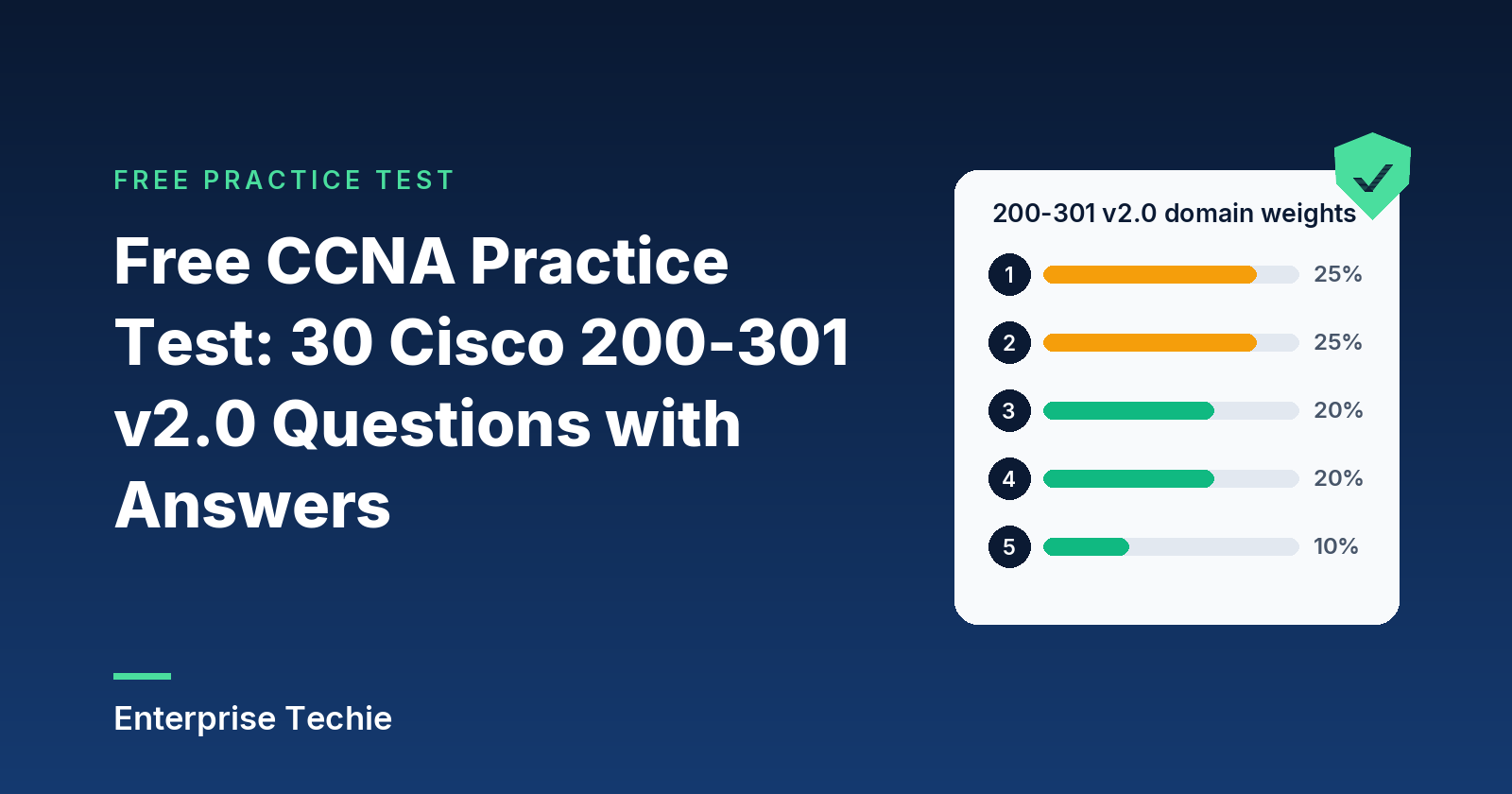
These 30 free Cisco CCNA 200-301 v2.0 practice questions each come with the answer and an explanation. Start with the quick check: ten questions drawn at random and scored at the end. All 30 questions follow, with the answers hidden until opened.
The questions come from the Enterprise Techie question bank. Every question is written to the 200-301 v2.0 exam objectives and checked in a separate review against primary sources such as Cisco documentation and IETF RFCs. They are original practice questions, not questions from the real exam. For the material behind them, see the CCNA study guide.
On this page
What’s changing
Checked against Cisco’s pages on November 15, 2026.
- February 2, 2027: the last day to test on 200-301 CCNA v1.1.
- February 3, 2027: CCNA v2.0 goes live for testing. Cisco describes it as a change in depth rather than a total overhaul, with more practical assessment, security and AI throughout, and more troubleshooting (Cisco, July 1, 2026).
If you test on or before February 2, 2027, you sit v1.1. Key dates and which version you’ll sit: CCNA v2.0 start date and v1.1 last test date.
For every upcoming exam date, see the IT certification exam calendar.
Take the 10-question quick check
Free quick check · Cisco CCNA 200-301 v2.0
10 random questions, scored at the end
Ten questions drawn at random from the 30 below. Each answer shows the explanation, and the score at the end can be shared. Nothing is saved and there is no sign-up.
All 30 CCNA practice questions with answers
The 30 questions cover all 5 exam domains. Open an answer to see the explanation.
| Domain | Questions here |
|---|---|
| Network Infrastructure and Connectivity | 8 |
| Switching and Network Access | 7 |
| IP Routing | 6 |
| Network Services and Security | 6 |
| AI, and Network Operations and Management | 3 |
Users report slow, stalling transfers to a server. On the switch port, show interfaces reports full duplex and rising FCS and runt counters. The server's NIC reports half duplex and is logging late collisions. What is the most likely cause?
- A speed mismatch, with each side fixed at a different link speed setting
- A duplex mismatch, with only one side of the link at full duplex
- An MTU mismatch, with the server sending oversized jumbo frames
- An overlong copper run, with the cable longer than 100 meters
Show the answer
Answer: B. B is right: Cisco notes that in a duplex mismatch the late collisions appear on the half-duplex side, because the full-duplex side transmits without waiting its turn, while FCS, CRC, alignment or runt errors climb on the full-duplex side. A is wrong because two different fixed speeds stop the link from forming at all. C would show up as giants, not runts and late collisions. D can cause late collisions, but it does not explain why the two ends report different duplex settings.
An engineer hard-codes a switch port to speed 100 and duplex full. The PC's NIC on that port is left at autonegotiation. Once the link is up, what is the NIC most likely running?
- 100 Mbps full duplex, learned from the switch through negotiation
- 1000 Mbps full duplex, the highest speed that the NIC supports
- No link at all, because the switch port has negotiation disabled
- 100 Mbps half duplex, which leaves the link in a duplex mismatch
Show the answer
Answer: D. D is right: Cisco explains that the autonegotiating side sees no negotiation parameters from a hard-coded partner, so it settles at the 100 Mbps speed but defaults to half duplex, which mismatches the full-duplex switch port. A is wrong because duplex cannot be negotiated with a partner that has negotiation turned off. B is wrong because the switch port is fixed at 100 Mbps. C is wrong because the link does come up; only a speed mismatch between two fixed ends stops it.
A server NIC is fixed at 100 Mbps and its switch port is fixed at 1000 Mbps, with autonegotiation off on both. What will the engineer observe?
- The link stays down on both ends because the speeds differ
- The link comes up at 100 Mbps and logs many late collisions
- The link comes up at 1000 Mbps and logs many CRC errors
- The link comes up at 100 Mbps but runs in half duplex
Show the answer
Answer: A. A is right: Cisco's compatibility table shows that when both partners are fixed at different speeds, neither side establishes a link. B and D describe a link that formed, which a fixed speed mismatch prevents; late collisions and half duplex are symptoms of a duplex problem. C is wrong for the same reason, and CRC errors can only be counted on a working link.
A switch port facing a storage array shows a steadily rising giants counter, with no CRC, runt or collision errors. The array's NIC was recently set to send jumbo frames. Which explanation fits these counters?
- A damaged cable is adding noise that corrupts frames in transit
- The port and NIC disagree on duplex, so their frames are colliding
- Incoming frames exceed the maximum packet size the port accepts
- The NIC is sending frames that fall below the 64-byte minimum
Show the answer
Answer: C. C is right: Cisco defines giants as packets discarded because they exceed the maximum packet size of the medium, which is what a jumbo-frame sender produces on a port without a matching MTU. A would raise the CRC counter, which is clean. B would show collisions or FCS and runt errors. D describes runts or undersize frames, the opposite of giants.
A legacy controller connects to a switch port, and both ends are set to 10 Mbps half duplex. Ordinary collisions are expected on this link, but the port is also logging late collisions. Which cause should the engineer investigate?
- The controller is sending frames that are larger than 1518 bytes
- The cable or segment is longer than its supported length
- Auto-MDIX must be disabled for half-duplex operation
- A speed mismatch exists between the two link partners
Show the answer
Answer: B. B is right: Cisco names a duplex mismatch and an Ethernet cable or segment that is too long as causes of late collisions; with matching duplex settings, the segment length is the leading suspect. A would raise the giants counter instead. C is wrong because Auto-MDIX handles cable pair crossing and has nothing to do with collision timing. D is wrong because the link is up and both ends are set to 10 Mbps.
Two Catalyst switches are joined with a straight-through copper patch cable, and the link comes up normally. Which switch feature explains why no crossover cable was needed?
- PortFast, which moves the port straight to forwarding
- UDLD, which detects and disables one-way fiber links
- CDP, which exchanges device details with the neighbor
- Auto-MDIX, which detects the cable type and adapts
Show the answer
Answer: D. D is right: with Auto-MDIX, the interface detects whether a straight-through or crossover connection is needed, and the link comes up even if the cable type is wrong; Cisco enables it by default. A only shortens spanning-tree convergence on edge ports. B detects unidirectional links. C is a discovery protocol that runs only after the link is already up.
Two switches were linked with a straight-through cable and worked. An engineer then hard-coded speed 100 and duplex full on both connected ports, and the link went down and stayed down. What is the most likely reason?
- Auto-MDIX needs speed and duplex set to auto, so the cable type now matters
- Both ports now run at half duplex, which keeps the link from forming at all
- A fixed speed disables CDP, so the two ports can no longer discover each other
- A 100 Mbps link needs all four wire pairs, which this patch cable lacks
Show the answer
Answer: A. A is right: Cisco states that for Auto-MDIX to operate correctly the interface speed and duplex must also be set to auto, so after hard-coding, the switch-to-switch link needs a crossover cable. B is wrong because both ends were set to full duplex, and duplex settings do not stop a link from forming. C is wrong because CDP is unrelated to link establishment. D is wrong because 10BASE-T and 100BASE-TX use two pairs; four pairs are needed for 1000BASE-T.
A cable tester shows that pin 1 at one end of a cable connects to pin 3 at the other end, and pin 2 connects to pin 6. What type of cable is it, and where was it traditionally required?
- Straight-through, required between a PC and a switch
- Rollover, required for a router's console connection
- Crossover, required between two switches without Auto-MDIX
- Straight-through, required between two routers' Ethernet ports
Show the answer
Answer: C. C is right: Cisco identifies a crossover cable by pin 1 at one end landing on pin 3 at the other and pin 2 landing on pin 6, and calls for one between like ports such as switch to switch. A and D are wrong because a straight-through cable keeps each pin on the same pin number, and router to router is a like-port connection that traditionally needs a crossover. B is wrong because a rollover cable reverses the whole pin order end to end.
On a Catalyst 9300, an engineer enters no switchport on GigabitEthernet1/0/24 and assigns it an IP address to link directly to a router. Which statement describes the interface now?
- It is a Layer 3 routed port that belongs to no VLAN and does not run DTP or STP.
- It is a trunk port that carries all VLANs and routes between them with that IP.
- It is a Layer 2 access port in VLAN 1 that also answers ARP for its own IP address.
- It is a switch virtual interface that represents VLAN 1 to the routing function.
Show the answer
Answer: A. Cisco describes a routed port as a physical port in Layer 3 mode (no switchport) that is not associated with any VLAN and does not support Layer 2 protocols such as DTP and STP. C describes an access port, which does not take an IP address. D describes an SVI, a logical interface rather than a physical port. B is wrong because a routed port is not a trunk and carries no VLANs.
A new Catalyst 9300 has SVIs for VLAN 10 (10.1.10.1/24) and VLAN 20 (10.1.20.1/24), both up/up. Hosts in each VLAN use their SVI as the default gateway and can ping it, but hosts in VLAN 10 cannot reach hosts in VLAN 20. No ACLs are configured. What is the most likely cause?
- IP routing is disabled by default, so the switch is not routing between its SVIs.
- Each VLAN needs its own physical router port before the SVIs can forward packets.
- Hosts in each VLAN need a static ARP entry for the other VLAN's gateway address.
- The SVIs must first be added to a trunk's allowed list before they can route any traffic.
Show the answer
Answer: A. Cisco's Catalyst 9300 guide states that IP routing is disabled by default on all devices. Until ip routing is entered globally, the switch does not forward packets between its SVIs, even though each SVI answers pings from its own VLAN. B is wrong because the SVIs are the Layer 3 interfaces; no extra router port is needed. D confuses SVIs with VLANs carried on a trunk. C is wrong because hosts ARP only for their own gateway, which they already reach.
A router's GigabitEthernet0/0/1 connects to a switch trunk that carries VLANs 10 and 20. Hosts in VLAN 20 use 10.20.0.1/24 as their gateway. Which router configuration provides that gateway?
- interface Gi0/0/1 / switchport trunk allowed vlan 20 / ip address 10.20.0.1 255.255.255.0
- interface Gi0/0/1.20 / switchport access vlan 20 / ip address 10.20.0.1 255.255.255.0
- interface Gi0/0/1.20 / vlan dot1q tag native / ip address 10.20.0.1 255.255.255.0
- interface Gi0/0/1.20 / encapsulation dot1Q 20 / ip address 10.20.0.1 255.255.255.0
Show the answer
Answer: D. Routing between VLANs over an 802.1Q link uses one subinterface per VLAN: encapsulation dot1q names the VLAN identifier, and the gateway address goes on that subinterface. B and A use switchport commands, which configure switch ports, not router subinterfaces. C is wrong because vlan dot1q tag native is a global switch command for tagging native VLAN frames; it does not bind a subinterface to VLAN 20.
A switch trunk to a router uses native VLAN 99. The router has subinterface Gi0/0/1.99 with encapsulation dot1Q 99 and IP 10.99.0.1/24, plus working subinterfaces for VLANs 10 and 20. Hosts in VLANs 10 and 20 reach their gateways, but hosts in VLAN 99 cannot reach 10.99.0.1. What fixes this?
- Remove VLAN 99 from the switch's allowed list so the router receives it untagged.
- Add switchport trunk native vlan 99 to the router's physical Gi0/0/1 interface.
- Enable ip routing on the router so that the VLAN 99 subinterface can forward.
- Change Gi0/0/1.99 to encapsulation dot1Q 99 native so untagged frames map to it.
Show the answer
Answer: D. The switch sends native VLAN 99 frames untagged. On the router, untagged frames belong to the native VLAN, which is VLAN 1 unless a subinterface is marked native, so the .99 subinterface (expecting tag 99) never receives them. Adding the native keyword makes it the handler for untagged traffic. B is a switch-port command, not router subinterface configuration. A would stop VLAN 99 crossing the trunk at all. C is wrong because reaching the subinterface's own address needs no routing between subnets; the problem is tagging.
An engineer plans to create subinterface TenGigabitEthernet1/1/1.30 on a Catalyst 9300 to reach a router over VLAN 30. Te1/1/1 is still a default switch port. According to Cisco's procedure, what must be configured on Te1/1/1 first?
- switchport nonegotiate, so the parent stops sending DTP
- interface Vlan30, so the subinterface can borrow its IP
- switchport mode trunk, so that the parent carries VLAN 30
- no switchport, so that the parent becomes a routed interface
Show the answer
Answer: D. Cisco's Catalyst 9300 procedure makes the parent a routed interface with no switchport; Layer 3 subinterfaces exist on Layer 3 physical interfaces and Layer 3 port channels. C keeps the port at Layer 2. B creates an SVI, which is a different way to route VLAN 30 and does not enable subinterfaces. A only stops DTP on a Layer 2 port.
Two new Catalyst 9300 switches are cabled together, and neither connected port has any switchport mode configured. What does the link become?
- A trunk, since both ports default to dynamic desirable and actively ask for a trunk link.
- An err-disabled link, since DTP detects two ports with identical default settings.
- An access link, since both ports default to dynamic auto and neither starts trunking.
- A trunk, since every Catalyst port defaults to trunk mode with all VLANs allowed.
Show the answer
Answer: C. Cisco documents dynamic auto as the default switchport mode, and an auto port becomes a trunk only if its neighbor is set to trunk or desirable. With auto on both ends neither side initiates, so the link stays an access link. A and D misstate the default mode. B is wrong because matching DTP modes do not err-disable a port.
SW1's uplink is left at dynamic auto. Which two settings on SW2's connected port will result in a working trunk? (Choose two.)
- switchport mode access
- switchport mode dynamic auto
- switchport mode trunk
- switchport mode dynamic desirable
Show the answer
Answers: C and D. A dynamic auto port converts the link to a trunk when its neighbor is in trunk or desirable mode, because those modes ask for a trunk. B pairs auto with auto, so neither side starts negotiation and the link stays access. A makes the neighbor a permanent nontrunking port.
R1's routing table contains these entries: S 172.16.0.0/16 [1/0] via 10.0.0.2 D 172.16.0.0/20 [90/3072] via 10.0.0.10, 00:05:41, GigabitEthernet0/0/2 O 172.16.9.0/24 [110/30] via 10.0.0.6, 00:03:12, GigabitEthernet0/0/1 A packet arrives for 172.16.9.77. Which next hop does R1 use?
- 10.0.0.6, because 172.16.9.0/24 is the longest prefix containing the address
- 10.0.0.2, because the static route has the lowest administrative distance
- 10.0.0.10, because internal EIGRP has a lower administrative distance than OSPF
- 10.0.0.2, because routes are checked from the shortest prefix to the longest
Show the answer
Answer: A. A is right: all three prefixes contain 172.16.9.77, and the router forwards on the longest matching prefix, which is the OSPF /24. B and C apply administrative distance, but AD only chooses between sources offering the same prefix and length, and these three prefixes differ. D reverses the rule: the most specific match wins, not the least specific.
R2 learns 192.168.50.0/24 from both OSPF and internal EIGRP, and both protocols run with default settings. Which route does R2 install in its routing table?
- The OSPF route, because link-state routes are preferred over distance-vector routes
- The EIGRP route, because internal EIGRP's default distance of 90 beats OSPF's 110
- The route with the lower metric, because metric is compared before distance
- Both routes, because the router load-balances one prefix across two protocols
Show the answer
Answer: B. B is right: when several sources offer the same prefix, the router installs the source with the lowest administrative distance, and internal EIGRP (90) is lower than OSPF (110). A fails because only the AD value matters, not the protocol type. D fails because routes for one prefix from different protocols are not installed together. C fails because EIGRP and OSPF metrics are not comparable; metric only separates paths from the same protocol.
A router has four candidate routes to 10.40.0.0/16, all with default administrative distances: one from internal BGP, one external EIGRP route, one from OSPF and one from RIPv2. Which route is installed?
- The internal BGP route, which carries a default administrative distance of 20
- The external EIGRP route, which carries a default administrative distance of 90
- The OSPF route, which carries a default administrative distance of 110
- The RIPv2 route, which carries a default administrative distance of 120
Show the answer
Answer: C. C is right: OSPF's default AD of 110 is the lowest of the four. A is wrong because internal BGP defaults to 200; 20 is the value for external BGP. B is wrong because external EIGRP defaults to 170; 90 applies only to internal EIGRP. D states RIP's AD correctly, but 120 is higher than OSPF's 110.
OSPF on R3 calculates two paths to 10.9.0.0/24: one with a cost of 20 through 10.1.1.2 and one with a cost of 30 through 10.1.2.2. No other routing source offers this prefix. What appears in R3's routing table?
- Both paths, because OSPF installs every path it learns and shares traffic in proportion to cost
- Only the path through 10.1.2.2, because a higher cost reflects the faster link
- Neither path until an administrative distance is configured to break the tie
- Only the path through 10.1.1.2, because OSPF installs the path with the lowest metric
Show the answer
Answer: D. D is right: metric decides between paths learned by the same protocol, and the lowest metric is installed; only equal-metric paths are load balanced. A fails because unequal-cost OSPF paths are not installed together. B inverts OSPF cost, where lower is better. C fails because administrative distance is not involved when a single protocol offers the prefix.
In the routing table entry `O 10.20.30.0/24 [110/65] via 10.0.0.1, 00:12:04, Serial0/1/0`, what do the numbers 110 and 65 represent?
- 110 is the OSPF process ID and 65 is the number of router hops to reach the network
- 110 is the administrative distance and 65 is the OSPF cost to reach the network
- 110 is the OSPF cost to the network and 65 is the administrative distance
- 110 is the route's age in seconds and 65 is the exit interface's bandwidth
Show the answer
Answer: B. B is right: Cisco's show ip route field descriptions define the first bracketed number as the administrative distance of the source and the second as the route's metric, which for OSPF is cost. C reverses the two values. A fails because the process ID never appears in the entry and OSPF does not use hop count. D fails because the route's age is the 00:12:04 field.
`show ip route` on a branch router begins with `Gateway of last resort is 203.0.113.1 to network 0.0.0.0` and includes `S* 0.0.0.0/0 [1/0] via 203.0.113.1`. What does this tell you?
- Every packet goes to 203.0.113.1 first, and specific routes are used only if it fails
- The router hands 203.0.113.1 to DHCP clients as their default gateway address
- A static default route via 203.0.113.1 is used for any destination with no better match
- ip default-gateway 203.0.113.1 is set because IP routing is turned off on the router
Show the answer
Answer: C. C is right: S* marks a static route that is also the candidate default, and the gateway of last resort line shows it is used for destinations that match nothing more specific. A reverses the logic, because specific routes are always preferred. D fails because ip default-gateway applies only when IP routing is disabled and does not appear as an S* route. B fails because the routing table says nothing about what DHCP gives clients.
A firewall sits between a router's management interface and the AAA servers. The router uses TACACS+ for administrator logins. Which transport and port must the firewall allow from the router to the TACACS+ server?
- UDP port 1812, the port assigned for authentication requests
- UDP port 49, since TACACS+ is connectionless like RADIUS
- TCP port 1813, the port reserved for accounting sessions
- TCP port 49, the port allocated for TACACS+ traffic
Show the answer
Answer: D. TACACS+ uses TCP for transport, and IANA allocates TCP server port 49 for it (RFC 8907). UDP 1812 is the RADIUS authentication port, and 1813 is RADIUS accounting over UDP, not a TCP port. TACACS+ does not run over UDP; its use of TCP is one of its main differences from RADIUS.
A security review notes that a packet capture of AAA traffic from a switch revealed usernames and the services each administrator was authorized for, although no passwords were visible. Which statement explains the finding and the protocol change that addresses it?
- TACACS+ hides only the password field, while RADIUS encrypts the entire packet payload
- RADIUS hides only the User-Password attribute; TACACS+ obfuscates the whole packet body
- RADIUS sends all attributes in clear text; moving it from UDP to TCP encrypts them
- TACACS+ encrypts only the header; enabling single-connection mode encrypts the body
Show the answer
Answer: B. RADIUS hides only the User-Password attribute in the Access-Request, so usernames, authorized services, and accounting data travel in the clear. TACACS+ encrypts the entire packet body and leaves only its standard header readable, so moving device administration to TACACS+ addresses the finding. RADIUS does not protect its whole payload, and it does not move to TCP. TACACS+ single-connection mode only keeps one TCP session open; it does not change what is encrypted.
An organization wants its routers to check with a central server before each configuration command an administrator enters, and to log each command executed. Authentication may later move to a different system while authorization stays central. Which protocol fits these requirements, and why?
- RADIUS, because Access-Accept replies carry per-command authorization lists
- RADIUS, because its UDP transport allows faster per-command authorization checks
- TACACS+, because it combines authentication and authorization into one reply
- TACACS+, because it separates authentication, authorization, and accounting
Show the answer
Answer: D. TACACS+ separates authentication, authorization, and accounting, so another system can authenticate users while TACACS+ still authorizes and logs each command. Cisco notes that command authorization and command accounting are things RADIUS cannot do. RADIUS combines authentication and authorization in the Access-Accept, and its UDP transport is not what enables per-command checks. Combining authentication and authorization describes RADIUS, not TACACS+.
A router has this configuration: aaa new-model aaa authentication login default group tacacs+ local username admin secret <strong-secret> The TACACS+ server is reachable, but the account 'admin' does not exist there, and the server replies with a FAIL. What happens when 'admin' tries to log in over SSH with the local password?
- The login succeeds, because the router tries the local database after any TACACS+ rejection
- The login is denied, because local is tried only if TACACS+ returns an error or no response
- The login succeeds, because local accounts always take priority over server-based methods
- The login is denied, because the local method is ignored whenever aaa new-model is enabled
Show the answer
Answer: B. IOS tries the next method in a list only when the previous method returns an error or does not respond. A FAIL reply from a reachable TACACS+ server is a definitive rejection, so authentication stops and the local database is never consulted. Local accounts do not take priority over earlier methods in the list, and aaa new-model does not disable the local method; it is what makes method lists work.
An engineer enters 'aaa authentication login default group tacacs+ local' on a new IOS XE switch, but the switch rejects it as an unrecognized command. Which command must be entered first?
- login local, entered under line vty 0 15 on the switch
- ip domain lookup, entered in global configuration mode
- service password-encryption, entered in global mode
- aaa new-model, entered in global configuration mode
Show the answer
Answer: D. AAA commands are unavailable until AAA is enabled with 'aaa new-model' in global configuration mode. 'login local' under the VTY lines uses the local database without AAA but does not unlock the aaa commands. 'ip domain lookup' controls DNS resolution, and 'service password-encryption' obscures stored passwords; neither enables AAA.
On an IOS XE router with AAA enabled, an engineer defines a TACACS+ server named TAC1 at 10.0.1.12 that must use the shared key configured on the server. After entering 'tacacs server TAC1', which two commands complete the definition in TACACS+ server configuration mode? (Choose two.)
- address ipv4 10.0.1.12
- server-private 10.0.1.12 key <shared-secret>
- key 0 <shared-secret>
- aaa group server tacacs+ TAC1
Show the answer
Answers: A and C. In TACACS+ server configuration mode, 'address ipv4' sets the server's IP address and 'key' sets the shared secret, which must match the key on the server. 'server-private' is entered under an AAA server group to define a private server, not inside a 'tacacs server' block. 'aaa group server tacacs+' is a separate global command that creates an optional server group; it does not complete the server definition.
A team compares a generative AI chat assistant with an agentic AI system for network operations. Which behavior is characteristic of the agentic system?
- It returns one generated answer per prompt and leaves the planning to the engineer
- It follows fixed if-then rules that an engineer wrote in advance for each event
- It breaks a goal into steps, calls tools to act, and adjusts based on the results
- It flags statistical anomalies in telemetry and waits for a human to act on them
Show the answer
Answer: C. C is right: Cisco describes agentic AI as autonomous systems that perceive information, plan complex tasks and execute decisions toward a high-level goal, using tools to act and adjusting their strategy from feedback. A describes a generative AI assistant on its own, which depends on humans to plan and returns a single output per prompt. B is rules-based automation with fixed logic. D is pattern detection that produces alerts for people to act on, not goal-driven action.
In an agentic operations workflow, one agent notices CRC errors climbing on a distribution uplink. A second agent correlates the errors with an optic that was replaced the day before and names that optic as the likely cause. Which role does the second agent perform?
- Diagnostics, finding the root cause of a detected issue
- Monitoring, watching telemetry for anomalies to report
- Remediation, proposing a fix for an engineer to approve
- Learning, recording outcomes to improve future workflows
Show the answer
Answer: A. A is right: Cisco's AgenticOps model gives each agent a defined role, and a diagnostic agent finds the root cause of an issue that another agent detected. B describes the first agent, which detected the anomaly. C is the next step, proposing a fix such as replacing the optic, for an engineer to approve. D records the outcome after the work is done so that later workflows improve.
An engineer opens Cisco AI Canvas in Reasoning mode to investigate slow application performance at three sites, and AI Canvas produces a proposed investigation plan. What does Cisco's documented workflow expect the engineer to do next?
- Wait for the investigation to finish, then audit which agents the plan used
- Switch to Default mode so that the plan's workflows can make the changes
- Upload the running configuration of every device that the plan will examine
- Check the plan's scope, entities and time range, edit it if needed, and approve it
Show the answer
Answer: D. D is right: in Reasoning mode AI Canvas first creates a proposed plan, and the engineer reviews it, confirming that its scope, products, entities and time range match the objective, modifies it if necessary, and approves it before the investigation runs. A skips the plan review that happens before any step runs; the processing details are for understanding a result afterward. B misreads the purpose of the plan, which investigates rather than changes the network; workflows that write changes are a separate Default-mode feature. C is not required, because the investigation uses the products, agents and data already available within the engineer's permissions.
Frequently asked questions
Are these real CCNA exam questions?
No. They are original practice questions written to the 200-301 v2.0 exam objectives, not questions taken from the real exam.
How many questions are on the CCNA exam?
Cisco's 200-301 exam page does not list a question count. It lists the exam as 120 minutes long, and the v2.0 exam topics give the same length.
What is the passing score for CCNA 200-301?
Cisco does not publish one on its exam page. Cisco's CCNA certification page describes the exam as graded on a pass/fail basis.
Is the quick check score saved anywhere?
No. The quick check runs in the browser, and nothing is saved or sent. The share buttons create a link that carries only the score.
Sources: the questions come from the Enterprise Techie question bank. Test details are from Cisco, as cited in the CCNA study guide. Last checked: November 2026. Cisco and CCNA are trademarks of Cisco Systems, Inc. Enterprise Techie is not affiliated with or endorsed by Cisco.