A data center technician keeps the servers, network gear and cabling inside a data center running. You rack and replace hardware, run and label cables, swap failed parts and work through tickets, usually on a shift.
This guide is built from the 96 open US data center technician postings on Enterprise Techie’s job board on November 22, 2026, from 14 employers’ own careers pages. So every requirement and pay figure below comes from a real posting. The live list is on the data center technician jobs page.
What the job involves
The postings describe the same core work, whether the employer runs colocation buildings or GPU clusters for AI:
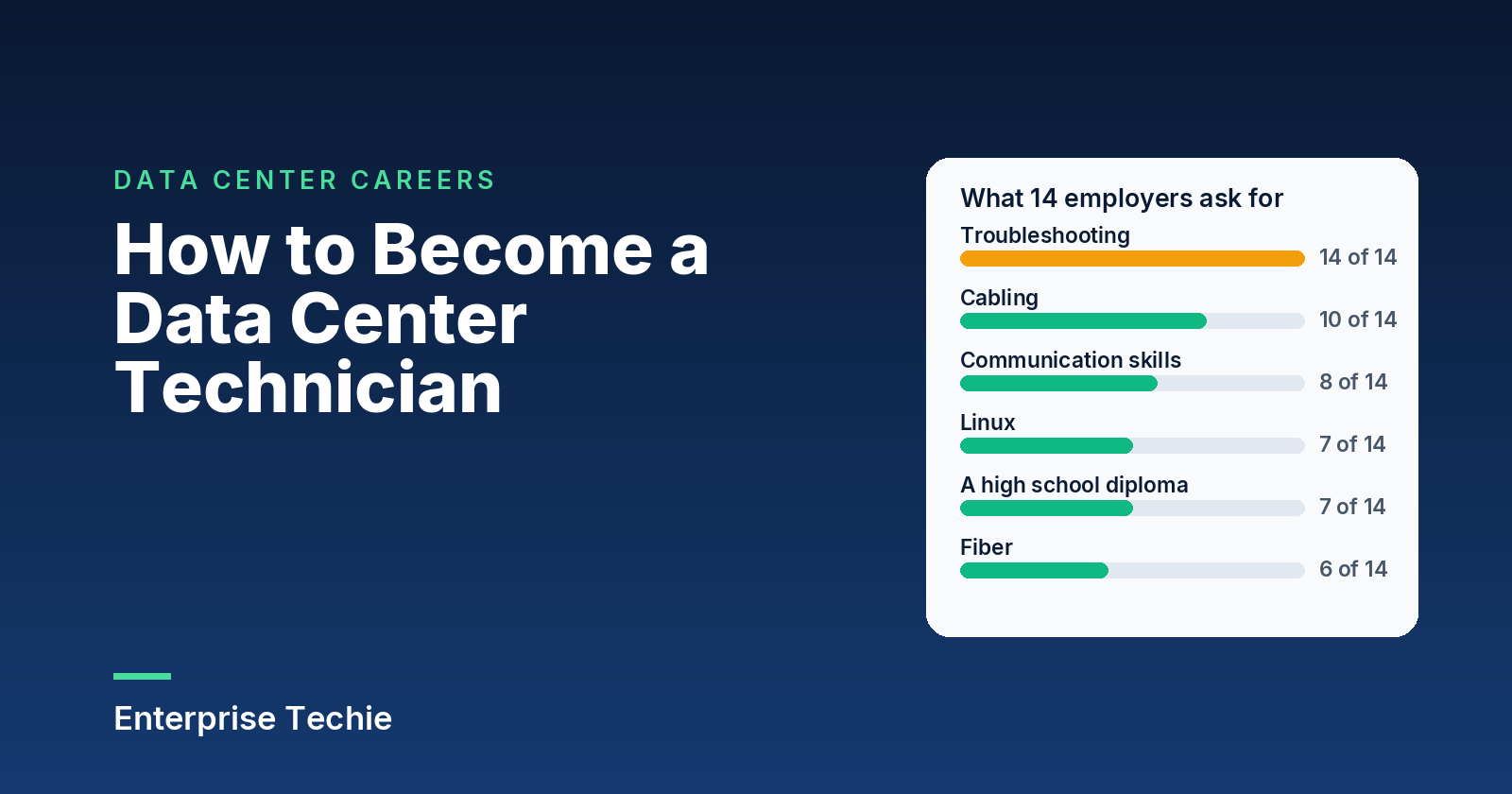
- Troubleshooting hardware. All 14 employers mention it. You find the failed drive, DIMM, power supply or optic, replace it and confirm the server is healthy again.
- Cabling. 10 of 14 mention cabling, and 6 mention fiber specifically. Expect to run, dress, label and test copper and fiber.
- Racking and installing. New servers and switches arrive by the pallet. Unboxing, racking, cabling and powering them up is a big share of the work at sites that are still growing.
- Linux and GPUs. 7 employers mention Linux and 7 mention GPU servers. Those are mostly the AI cloud providers, where a technician may run diagnostics from the command line before pulling a part.
- Tickets and procedures. Work arrives as tickets, and changes follow written procedures. Clear notes matter, because the next shift picks up where you left off.
Facilities technicians are a related track. They look after the power and cooling equipment the servers depend on: switchgear, UPS systems, generators and chillers. Those roles lean on electrical and HVAC skills more than IT skills, and they’re on the same job board.
What a shift looks like
Shifts start and end with a handover. CoreWeave’s command center posting asks for detailed event logs and structured shift handovers, and Nscale asks for clear incident tickets and shift handover notes. In between, the work follows written procedures: 8 of the 14 employers mention MOPs or SOPs, the method-of-procedure and standard-operating-procedure documents that spell out each change or maintenance task step by step.
Facilities roles add rounds. Yondr’s critical facility shift technician posting lists operations and rounds, walking the site to check equipment and catch problems before they become outages.
What employers want besides certificates
- Communication. 8 of the 14 employers ask for communication skills. You’ll write tickets and handover notes, and talk to engineers who aren’t on site.
- Following procedures. The same number mention MOPs or SOPs. Doing a task exactly as written, every time, is the core habit of the job.
- A safety mindset. You’ll work near live power and heavy equipment. One xAI posting asks for a “strong safety mindset” by name.
- A clean background check. Crusoe, TensorWave, Vultr and xAI mention one. Data centers hold other companies’ equipment, so access is controlled.
Do you need a degree?
For most technician roles, no. Seven of the 14 employers (CleanSpark, Cologix, Crusoe, Hut 8, Switch, Yondr and xAI) ask for a high school diploma or equivalent. Six mention a bachelor’s degree, and in every case it’s listed as preferred or experience counts instead. One xAI posting, for example, asks for a bachelor’s degree in mechanical or electrical engineering or two or more years of hands-on experience.
Experience matters more than paper. Requirements of two or three years of hands-on work with servers, networks or facilities equipment are common, and several employers also run entry-level programs. Nebius, for example, had Associate Data Center Technician and Early Talent openings on the board.
Certifications that help
No posting reviewed made an IT certification a hard requirement. When postings name one, the wording is flexible: “such as”, “preferred” or “or comparable certifications”. These are the ones that came up:
| Certification | Employers naming it (of 14) |
|---|---|
| CompTIA Network+ | 4: CoreWeave, Crusoe, Nscale, Switch |
| OSHA 10-hour or 30-hour card | 4: Crusoe, Switch, Yondr, xAI |
| NFPA 70E (electrical safety) training | 4: Crusoe, Switch, Yondr, xAI |
| BICSI cabling credentials | 3: Cologix, Crusoe, xAI |
| CompTIA A+ | 2: CoreWeave, Switch |
| CompTIA Server+ | 2: CoreWeave, Crusoe |
| Cisco CCNA | 2: Crusoe, Nscale |
The data center technician certifications guide explains each one and which to start with. Enterprise Techie has free study guides for A+, Network+ and the CCNA.
The physical side and the schedule
This is on-your-feet work. Seven of the 14 employers put a number on lifting. 50 pounds is the most common figure, and the range runs from 25 pounds in one xAI posting to 100 pounds in one Switch posting. Postings also mention ladders, working at height, confined spaces and noise. A CoreWeave posting puts hot and cold aisle temperatures at 60°F to 90°F.
Data centers run around the clock, so someone is always on shift. At least six of the 14 employers (CoreWeave, Cologix, Nscale, Switch, Yondr and xAI) spell out nights, weekends, holidays or rotating shifts. One CoreWeave command center role runs 12.5-hour night shifts. Some roles also involve travel between sites. Check the shift and travel lines in each posting before you apply.
What it pays
These are the ranges employers published in their postings on November 22, 2026. They’re advertised ranges, not pay data, and postings change, so treat them as a snapshot. Postings titled data center technician ran from $26 to $46 an hour, or $48,000 to $100,000 a year.
| Employer | Role | Location | Posted pay |
|---|---|---|---|
| Nebius | Associate Data Center Technician | Oklahoma | $26 to $38 an hour |
| Vultr | Data Center Technician | Springfield, OH; Pryor, OK; Royse City, TX; Wise, VA; Piscataway, NJ; Kansas City, MO | $28 to $46 an hour |
| Nebius | Data Center Technician | Kansas City, MO; Oklahoma | $30 to $42 an hour |
| Nebius | Data Center Technician | Minnesota | $30 to $45 an hour |
| Nebius | Data Center Technician (Early Talent) | Kansas City, MO; Minnesota | $48,000 to $72,000 a year |
| Vultr | Data Center Technician | Eagan, MN; Lithia Springs, GA | $60,000 to $95,000 a year |
| CoreWeave | Data Center Technician | Sandusky, OH; Miami, FL; Elk Grove, IL; Ellendale, ND | $65,000 to $85,000 a year |
| CoreWeave | Data Center Technician | Cheyenne, WY; Dalton, GA; Afton, TX | $65,000 to $83,000 a year |
| Crusoe | Data Center Hardware Technician | Springfield, OH | $90,000 to $100,000 a year |
Many employers don’t list pay at all, so the job board shows a typical range only once 30 or more US postings publish one.
Where the jobs are
On November 22, 2026, the open US roles clustered in Tennessee and Mississippi, almost all from xAI’s Memphis-area sites, which list both states. Ohio (11), Texas (8), Georgia (8) and Nevada (6) came next. The list changes every hour, and the data center technician jobs page has a filter for each state.
How to get your first role
- Learn PC and server hardware. Know what each component does and how to swap it safely. The A+ Core 1 study guide covers the hardware side.
- Learn networking basics. Ports, VLANs, cabling standards and how a switch uplinks. The Network+ study guide and the subnet calculator help here.
- Get comfortable on the Linux command line. Seven of the 14 employers mention Linux, mostly for running hardware diagnostics.
- Practice cabling. Terminate, label and test cables until it’s routine. Neat, labeled work is what the next shift notices.
- Take a safety course. One Switch posting asks new hires to get an OSHA 10 card within six months, so arriving with one already done helps.
- Apply to entry-level postings. Look for associate, early talent or level I titles on the data center technician jobs page, and filter by your state.
Where the job leads
The titles on the board show the ladder. Associate and level I technician roles lead to senior technician, then to data center operations engineer roles. Lambda, for example, lists Data Center Operations System Engineer II at $89,000 to $119,000 and level III at up to $145,000, and Crusoe lists a Senior Data Center Operations Engineer at $110,000 to $165,000. Other technicians move into networking (Switch hires Network Infrastructure Technicians), hardware diagnostics (Nebius lists a Senior Data Center Diagnostic and RMA Specialist at $112,700 to $140,800) or critical facilities.
Frequently asked questions
Do you need a degree to become a data center technician?
Usually not. Seven of the 14 employers in Enterprise Techie’s November 2026 review ask for a high school diploma or equivalent. Six mention a bachelor’s degree, and each time it’s preferred or experience counts in its place.
What certifications do data center technicians need?
None is a hard requirement in the postings reviewed. CompTIA Network+ (4 of 14 employers), CompTIA A+, Server+ and Cisco CCNA (2 each), BICSI cabling credentials (3) and OSHA safety cards (4) are the ones named most. The data center technician certifications guide covers each one.
How much do data center technicians make?
Postings titled data center technician that list pay ran from $26 to $46 an hour, or $48,000 to $100,000 a year, on November 22, 2026. That’s what employers advertise, not what people are paid, and it varies by employer and site.
Do data center technicians work nights and weekends?
Often. At least six of the 14 employers spell out nights, weekends, holidays or rotating shifts, because data centers run around the clock. Each posting says which shift it’s hiring for.
Is data center technician work physical?
Yes. Seven of the 14 employers state a lifting requirement, most often 50 pounds. Postings also mention ladders, working at height, noise and hot and cold aisles; one CoreWeave posting gives aisle temperatures of 60°F to 90°F.
Sources
- The 96 open US data center technician postings on Enterprise Techie’s data center technician jobs page on November 22, 2026, from the careers pages of CleanSpark, Cerebras, Cologix, CoreWeave, Crusoe, Hut 8, Lambda, Nebius, Nscale, Switch, TensorWave, Vultr, xAI and Yondr. Pay figures are as each employer published them.
- Counts are by employer: an employer counts once if any of its open US postings mentions the item.
Checked against the employers’ postings on November 22, 2026.